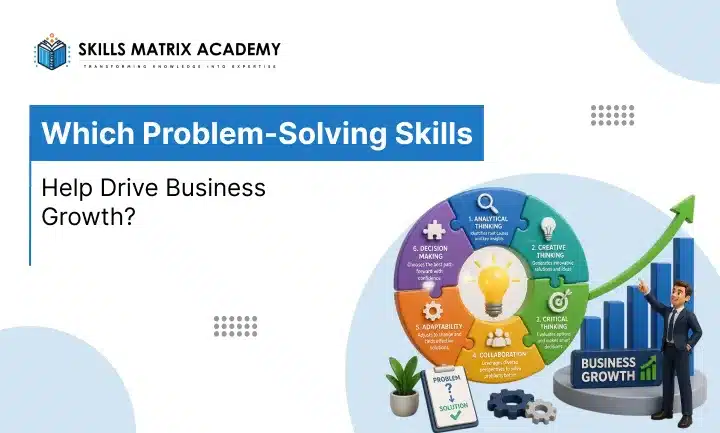
Every business faces problems. Sales slow down, customers complain, teams struggle to communicate, and markets shift overnight. What separates growing companies from struggling ones isn’t the absence of challenges — it’s leaders who know how to solve them effectively. The good news is that problem-solving is not a talent you are born with. It is a skill you can learn, practise, and improve over time.
What Are Problem-Solving Skills?
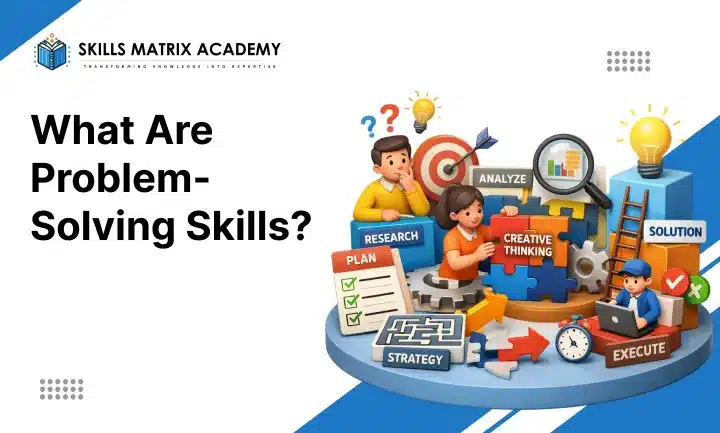
Problem-solving skills are the abilities that help people identify challenges, understand their root causes, and find effective solutions. In a business context, these skills go far beyond simply fixing what is broken, they involve analytical thinking, creative exploration, and decisive action.
When leaders and teams develop strong problem-solving skills, businesses are able to:
- Increase productivity and remove workflow bottlenecks
- Improve customer satisfaction by addressing pain points quickly
- Build stronger, more aligned teams
- Reduce costly mistakes and avoid repeating them
- Create healthier, more collaborative workplace environments
Even small problems can turn into big challenges when they aren’t solved on time. A customer complaint left unresolved becomes a reputation problem. A process inefficiency left unchecked becomes a productivity drain. Addressing challenges early and systematically is what keeps businesses on a growth path.
Why Problem-Solving Skills Matter in Entrepreneurship
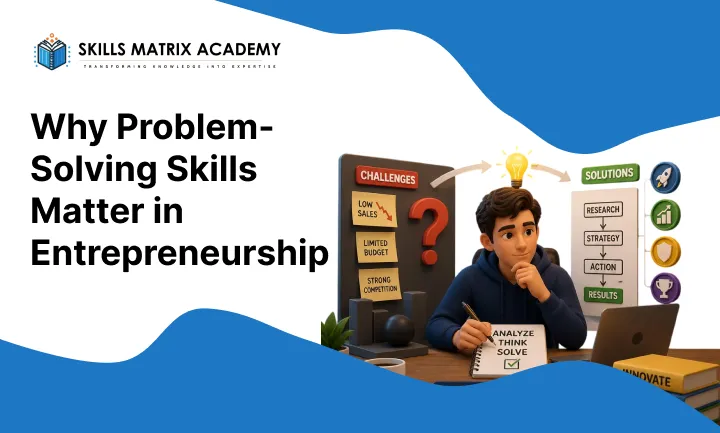
Entrepreneurship is inherently unpredictable. One quarter, sales surge; the next, a competitor disrupts the market or customer expectations shift entirely. Leaders who thrive in this environment share one thing in common: they know how to stay calm under pressure, think clearly, and make smart decisions quickly.
Business growth strategies often fail because leaders focus only on opportunities while ignoring underlying problems. The most effective entrepreneurs do the opposite, they study problems deeply, because every business challenge hides a potential opportunity. Companies like Zomato and Swiggy didn’t just solve a logistics problem. They identified a gap in the market, thought creatively about convenience and speed, and built entire industries around that insight.
Whether you are managing a startup or leading an established company, strong problem-solving skills are among the most valuable assets you can develop.
13 Problem-Solving Skills That Drive Business Growth
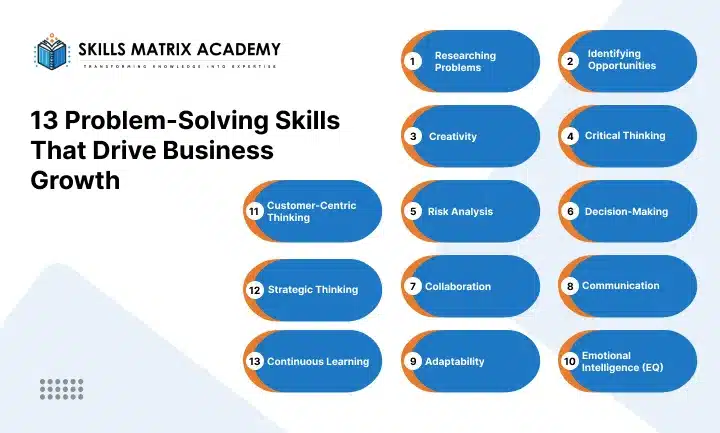
01.Researching Problems
Successful entrepreneurs don’t rely on guesses, they research before they act. When a problem arises, the instinct to act immediately can be counterproductive. Instead, gather data: analyse customer behaviour, review competitor strategies, examine market trends, and collect team feedback. Thorough research separates surface-level symptoms from the actual root cause.
02. Identifying Opportunities
Every problem contains a hidden opportunity for those willing to look. Businesses that pivoted to online services during COVID-19 didn’t just survive many grew significantly faster than before. Train yourself to ask, “What new opportunity can this problem create?” turns setbacks into strategic advantages.
03. Creativity
Logic narrows down options; creativity expands them. The best innovations often come from taking smart risks, not staying too safe. Encourage open brainstorming sessions where no idea is immediately dismissed. Creating psychological safety within a team is one of the most powerful ways to unlock creative problem-solving.
04. Critical Thinking
Critical thinking means evaluating situations based on evidence rather than assumptions or emotions. Before acting, ask: What data supports this decision? What are the realistic risks? Are there alternative explanations? This habit of structured thinking leads to better, more defensible decisions over time.
05. Risk Analysis
Every decision carries some level of risk. The aim is not to avoid every risk, but to understand and handle it wisely. Tools like SWOT analysis (Strengths, Weaknesses, Opportunities, Threats) give leaders a structured way to assess risk before committing to a major change or investment.
06. Decision-Making
Not making a decision is also a decision and it can sometimes cost the most. Great leaders gather the necessary information, weigh their options, and act with confidence. When a strategy isn’t working, they adapt quickly rather than defending a failing course of action. Speed and clarity in decision-making create real competitive advantages.
07. Collaboration
Complex problems rarely have single-person solutions. Bringing in diverse perspectives from different departments, backgrounds, or roles consistently produces stronger ideas. Leaders who involve their teams in problem-solving also build higher levels of trust, engagement, and ownership across the organisation.
08. Communication
A brilliant solution means nothing if it isn’t communicated clearly. Miscommunication is one of the most common causes of implementation failure. Strong communicators ensure that everyone affected by a solution understands the what, why, and how reducing confusion and increasing the likelihood of successful execution.
09. Adaptability
Markets evolve, technology advances, and customer expectations rise continuously. The businesses that endure are those that treat adaptability as a core competency. Rather than resisting change, adaptive leaders learn to move with it adjusting strategies, processes, and priorities as new information emerges.
10. Emotional Intelligence (EQ)
High emotional intelligence allows leaders to stay composed when situations become difficult. Instead of reacting impulsively under stress, emotionally intelligent leaders pause, reflect, and respond thoughtfully. This quality also helps them navigate team conflicts more constructively and build stronger interpersonal relationships.
11. Customer-Centric Thinking
The most valuable source of insight into a business’s problems is often its customers. Leaders who actively listen to customer feedback through surveys, support interactions, or reviews can identify issues before they escalate. Apple’s long-term success is rooted in a relentless focus on making the customer experience simpler, more intuitive, and more enjoyable.
12. Strategic Thinking
Strategic thinkers solve problems with the long term in mind. Rather than applying quick fixes that address today’s issue but create tomorrow’s problem, they design systems and processes built to last. Before implementing any solution, ask: Will this still serve us well in two or three years?
13. Continuous Learning
The business landscape changes too rapidly for knowledge to stay static. The most effective leaders read widely, study both successes and failures, seek mentorship, and remain genuinely curious. The habit of continuous learning ensures that your problem-solving toolkit keeps pace with the challenges you will face.
The 5 Steps of the Problem-Solving Process
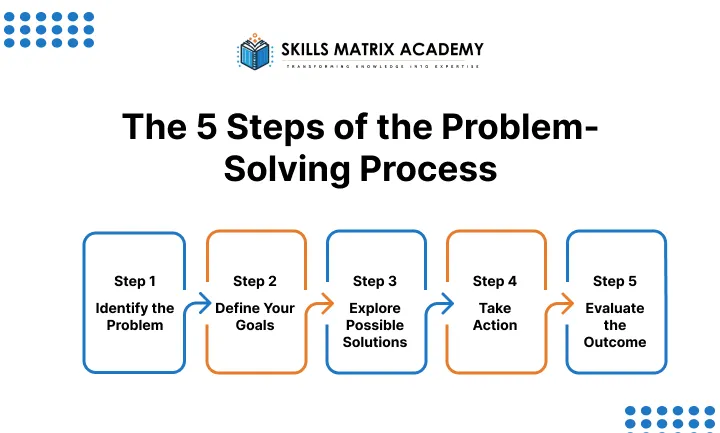
The IDEAL model, developed by psychologists John D. Bransford and Barry S. Stein, provides a practical framework for working through any business challenge in a structured, repeatable way.
Step 1: Identify the Problem
Resist the urge to jump to solutions. Before anything else, understand what is actually going wrong. Ask: Why is this happening? How widespread is the issue? What patterns exist? Solving the wrong problem or treating a symptom as the cause wastes time, money, and energy.
Step 2: Define Your Goals
Clarify exactly what success looks like. Clear, specific goals whether improving customer retention by 10%, reducing response time, or cutting production costs give your team a measurable target to work toward.
Step 3: Explore Possible Solutions
Gather relevant data, brainstorm a range of options, and analyse the risks and trade-offs involved. Avoid rushing to the first plausible solution. The most effective answer often emerges only after careful evaluation of multiple alternatives.
Step 4: Take Action
Choose the best available option and implement it with clarity. Assign responsibilities, set deadlines, communicate the plan across the team, and track progress closely. A well-designed solution poorly executed will still fail.
Step 5: Evaluate the Outcome
After implementation, measure the results honestly. Did the solution achieve the intended goal? What worked well and what could be improved? Systematic evaluation builds organisational learning and helps prevent the same problems from recurring.
Common Mistakes to Avoid
Even well-intentioned leaders can undermine their problem-solving efforts. Watch out for these patterns:
- Treating symptoms, not causes: If the same problem keeps returning, the root cause has not been addressed. Always dig deeper.
- Making decisions emotionally: Frustration, urgency, or personal bias can distort judgment. Anchor decisions in data wherever possible.
- Ignoring feedback: Customers and employees often see problems long before leaders do. Build regular feedback channels and take them seriously.
- Delaying action: Excessive analysis can be as harmful as acting too quickly. Set a decision deadline and commit to it.
- Resisting change: Clinging to familiar methods in a changing environment is a recipe for being overtaken by more adaptive competitors.
Practical Tips to Sharpen Your Skills
- Listen actively: Understand the full picture before forming an opinion or proposing a fix.
- Decompose large problems: Break complex challenges into smaller, manageable components to make progress easier to track.
- Invite diverse perspectives: The person closest to a problem is not always the best person to solve it. Bring in outside viewpoints.
- Study real cases: Analyse how other companies have handled similar challenges both their successes and their failures.
- Cultivate curiosity: Ask ‘why’ and ‘what if’ often. Curiosity is the foundation of innovative thinking.
Final Thoughts
Business problems are not a sign of failure they are a sign that your organisation is operating in the real world. Every challenge you face is an opportunity to strengthen your decision-making, deepen your understanding of your market, and build more resilient systems.
The leaders who grow most consistently are not those who face fewer problems. They are those who have developed the skills, mindset, and processes to work through challenges with clarity and confidence.
Pause before reacting. Study the problem carefully. Think critically. Take action confidently. Business growth doesn’t happen without solving hard problems first.
Frequently Asked Questions
01. What are problem-solving skills in entrepreneurship?
They are the abilities that help business owners identify challenges, think through their causes, and implement solutions that support sustainable growth.
02. Why are problem-solving skills important for managers?
Managers rely on these skills to maintain team productivity, handle conflict constructively, and keep day-to-day operations running smoothly.
03. What is the IDEAL problem-solving model?
A five-step framework: Identify the problem, Define your goals, Explore possible solutions, Act on the best option, and evaluate the outcome.
04. How can entrepreneurs improve their problem-solving abilities?
Through consistent practice of critical thinking, deep research, real-world case studies, feedback loops, and a genuine commitment to continuous learning.
05. What is the most common problem-solving mistake in business?
Addressing symptoms rather than root causes which guarantees the same problem resurfaces, often in a more damaging form.

Bharat Arora
12+ years as a web developer, Bharat has worked in the biggest IT companies in the world. He loves to share his experience in web development.


Bharat Arora
12+ years as a web developer, Bharat has worked in the biggest IT companies in the world. He loves to share his experience in web development.