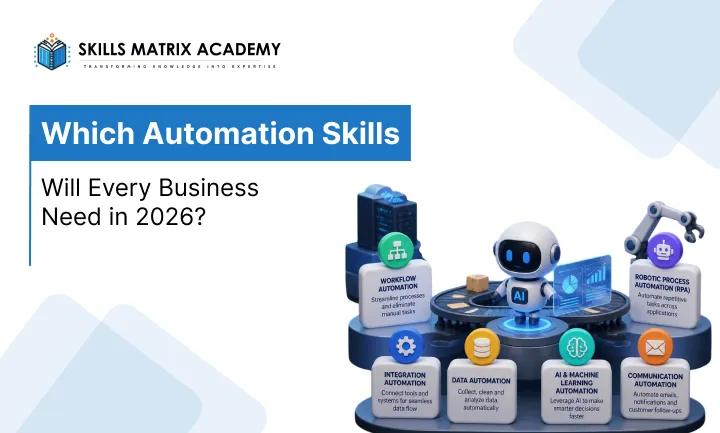
Most businesses know they should automate. Few know where to start or what skills they actually need to make it work.
What Is Business Automation?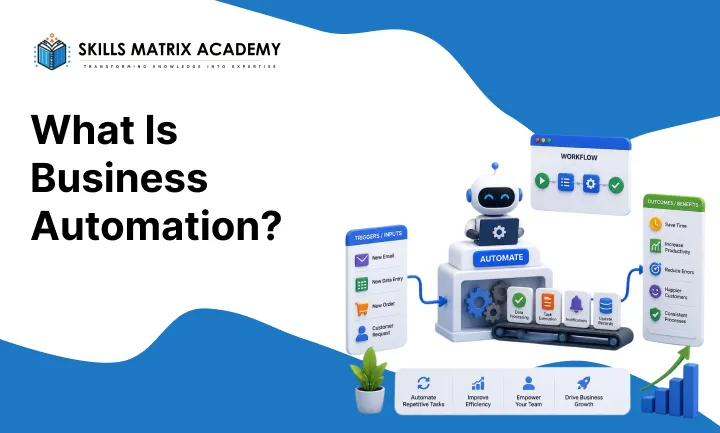
Business automation is simple: you use software to handle repetitive work, so your team does not have to.
Instead of manually sending invoices, posting on social media, or replying to the same customer questions every day, a system handles all of that for you. Automatically. Every time.
A few years ago, setting this up was expensive and complicated. Today, most automation tools are affordable, easy to use, and built for small businesses.
Here are the most common things businesses automate:
- Appointment scheduling
- Customer support and FAQs
- Invoice sending and payment reminders
- Email marketing and follow-ups
- Social media posting
- Daily reports and dashboards
- Job applications and hiring
- Inventory tracking and stock alerts
The goal is not to replace people. The goal is to free people from boring, repetitive work, so they can focus on things that actually need a human brain.
Why Automation Matters More Than Ever

Running a business is more challenging today. Customers want quick responses, teams are overloaded, and companies are trying to achieve more with fewer resources.
Manual systems slow everything down. When every step in a process needs someone to do it by hand, you get delays, mistakes, and burnout.
Here is a simple example. A business owner who manually replies to every customer email can lose 2 to 3 hours every day. An automated system handles the common questions instantly. The team only steps in when a real conversation is needed.
That time adds up fast. A task that takes 20 minutes a day costs over 80 hours a year. Automate five tasks like that, and you have effectively created a full-time employee’s worth of time , without hiring anyone.
Businesses that wait too long to automate are not just missing out; they are also risking their future. They are falling behind competitors who respond faster, operate more cheaply, and scale more easily.
5 Automation Skills Every Business Needs
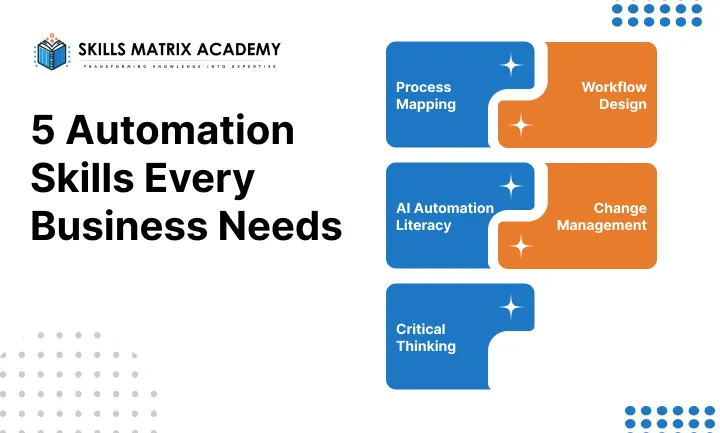
Good software is not enough on its own. The businesses that get the most from automation are the ones that also develop the right skills. Here are the top five skills every business should focus on.
01. Process Mapping
Before you automate anything, you need to understand how your current process actually works.
Process mapping means documenting every step, decision, and handoff in a workflow. It forces you to see where things slow down, where steps are duplicated, and where responsibilities are unclear.
This step is critical. If you automate a broken process, you do not fix it, you make it break faster. Always map first, then automate.
02. Workflow Design
Once you understand a process, you need to design a better version of it, one that can run on its own with little human input.
Workflow design means knowing how your tools connect, how information moves between them, and how to handle the unexpected. A well-designed workflow keeps running smoothly even when something unusual happens.
03. AI Automation Literacy
Basic automation follows rules. If this happens, do that. AI automation is smarter. It learns from patterns and can make decisions on its own, like routing a customer complaint to the right person, spotting a fraudulent order, or recommending the next step for a sales lead.
Your team does not need to build AI from scratch. But they do need to understand what AI tools can do ,and where they fall short , so you can use them wisely.
04. Change Management
Here is the truth: most automation projects do not fail because of bad software. They fail because the team does not adopt the new system.
People worry about losing their jobs. They get frustrated by new tools. They quietly go back to old habits.
Good change management means involving your team early, explaining what is changing and why, and giving people the support they need to adjust. This skill is almost always underestimated, and almost always the deciding factor.
05. Critical Thinking
Automation is not set-it-and-forget-it. Systems break. Processes change. Customer needs shift.
Your team needs people who can spot problems before they become crises, figure out what went wrong, and improve the system over time. As automation takes over routine tasks, this kind of thinking becomes the most valuable skill in the building.
10 Things Every Business Should Automate First
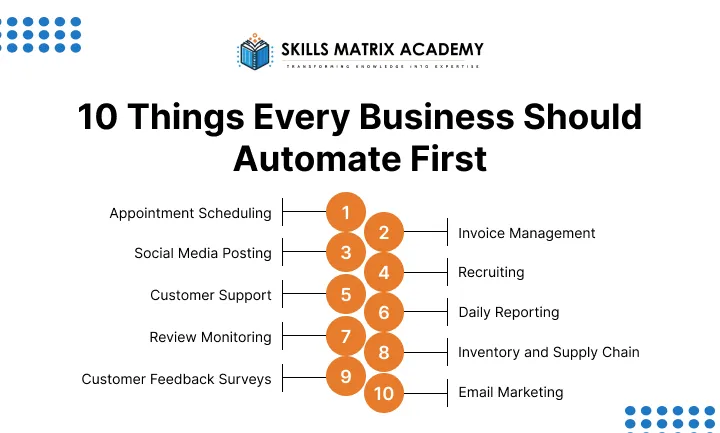
Not sure where to begin? Start here. These ten areas give you the biggest return for the least effort.
01. Appointment Scheduling
Let customers book their own meetings. Tools like Calendly eliminate the back-and-forth. Add a short intake form, and you will be prepared for every call before it starts.
02. Invoice Management
Send invoices automatically, track who has paid, and send reminders for overdue accounts. For service businesses and freelancers, this one change can make a big difference to cash flow.
03. Social Media Posting
Write your content in batches. Schedule it weeks in advance. Your accounts stay active and consistent without anyone needing to log in every day.
04. Recruiting
Applicant tracking systems sort applications, schedule interviews, and keep candidates updated without anyone having to manage them manually. Hiring becomes simple and organised, even during busy workdays.
05. Customer Support
A chatbot handles the common questions, opening hours, order status, pricing , at any time of day. Anything complex gets passed to a real person. Response times improve, and support costs stay manageable as you grow.
06. Daily Reporting
Connect your analytics tools to an automated dashboard. Instead of spending hours pulling numbers every week, you get a clear picture of performance every morning without lifting a finger.
07. Review Monitoring
Track new reviews across Google and other platforms as they come in. Responding quickly builds trust with customers and helps your local search rankings.
08. Inventory and Supply Chain
Get automatic alerts when stock is running low. Stay updated on delivery timelines. Reduce the risk of running out of what you need , or ordering too much of what you do not.
09. Customer Feedback Surveys
Send a short satisfaction survey automatically after every purchase or service. You get a steady stream of honest feedback without having to chase anyone for it.
10. Email Marketing
Set up your welcome emails, cart reminders, and follow-up sequences once. Then let them run. The right message reaches the right person at the right moment , automatically, every time.
What Good Automation Actually Delivers
Speed is the obvious benefit. But well-implemented automation does much more than that.
- Fewer mistakes. Less manual data entry means fewer errors in billing, reporting, and customer communication.
- More focus. When the routine work handles itself, your team can think bigger.
- Easier growth. Automated systems can handle more volume without needing more staff.
- Better decisions. Real-time dashboards give you accurate information without waiting for someone to compile it.
- Lower costs. Doing more with less is not just a goal, it becomes the reality.
Common Mistakes to Avoid
A few predictable mistakes cause most automation problems. Here is what to watch out for.
- Automating a broken process. Fix the problem first. Automation makes things faster , including the bad parts.
- Ignoring your team. If people are not brought in early, they will resist the change. Involve them from the start.
- No clear plan. Automating random tasks without a strategy creates a mess of disconnected tools that do not work together.
- Thinking launch is the finish line. Automation needs ongoing attention. Systems drift. Habits revert. Keep supporting the change after go-live
What the Future Looks Like
Automation is moving fast. AI-powered tools are becoming smarter, cheaper, and easier to use. What used to require a team of developers can now be set up in an afternoon.
But here is what will not change: businesses still need people who can think clearly, solve problems, and lead others through change. Those skills become more valuable as automation handles more of the routine work ,not less.
The businesses that will win are not the ones with the most software. They are the ones whose teams know how to build, run, and improve automated systems over time.
Frequently Asked Questions
What is business automation?
It uses software to handle repetitive tasks, like sending invoices, answering common customer questions, or posting on social media, so your team does not have to do them manually every time.
Why does workflow automation matter?
It saves time, reduces mistakes, and lets your team focus on work that actually needs human thinking. Over time, it also makes your business much easier to scale.
What tools should a small business start with?
Good starting points: Calendly for scheduling, Zapier for connecting apps, HubSpot for CRM and marketing, and Mailchimp for email. Start with one tool that solves a real pain, learn it well, then expand.
Which automation skills matter most?
Process mapping, workflow design, basic AI literacy, change management, and critical thinking. The technology is only as good as the people behind it.
How is AI automation different from regular automation?
Regular automation follows fixed rules. AI automation learns from data and makes smarter decisions on its own, like routing a support request to the right person or personalising a marketing email based on user behaviour.
Where to Go From Here
Automation is not something to figure out all at once. Start small. Pick one task that wastes your team’s time every week. Map the process. Find a tool that handles it. Get your team using it properly. Then move to the next one.
Done this way, automation builds on itself. Each improvement creates more time and capacity for the next one. Businesses that start this process early end up with a real advantage, one that is genuinely hard for competitors to catch up with.
The best time to start was a year ago. The second-best time is now.

Bharat Arora
12+ years as a web developer, Bharat has worked in the biggest IT companies in the world. He loves to share his experience in web development.


Bharat Arora
12+ years as a web developer, Bharat has worked in the biggest IT companies in the world. He loves to share his experience in web development.