Introduction
When you are building software, one decision quietly shapes everything else — the architecture you choose. It decides how fast your team moves, how easily you scale, how painful deployments feel, and how much your maintenance costs grow over time. Start strong, and the path forward becomes effortless. Get it wrong, and you’ll feel the weight of that choice for years.
Two approaches dominate the conversation today: monolithic architecture and microservices architecture. Both are proven. Both are widely used. And both have situations where they shine — and situations where they genuinely struggle.
So when it comes to microservices vs monolith, which one should you actually pick? That depends on where you are right now, where you’re heading, and what your team is honestly capable of. Let’s walk through both in a clear, honest way — no hype, no jargon overload.
What Is Monolithic Architecture?

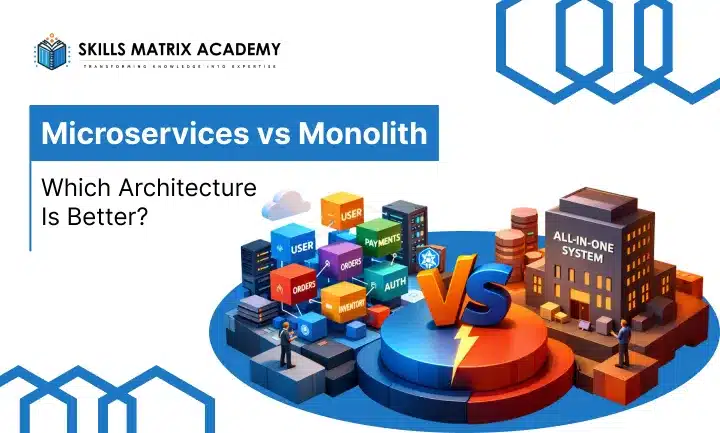
Think of a monolithic architecture as one big house where every room serves a purpose — kitchen, bedroom, office — but the walls are all shared. Everything lives under the same roof, connected to the same foundation.
In a monolith, your entire application is built as a single unit. The user interface, business logic, database layer, authentication, payments — all of it sits inside one codebase and gets deployed together as one package.
This sounds limiting, but for a long time it was the standard. And it still makes perfect sense in many cases.
Key Characteristics of Monolithic Architecture
- A single, unified codebase that contains all application features
- One deployment process for the entire system
- A shared database that all parts of the application access
- Tight coupling between components — changes in one area can affect others
A classic example is a small business e-commerce website where user login, product catalog, shopping cart, and payment processing all live in the same application. One server runs it all. One deployment updates it all. Simple and direct.
The honest truth is that a monolithic architecture is not “old-fashioned bad.” It’s a deliberate choice that removes a lot of early complexity. Many highly successful products were built this way — and some stayed that way for years without breaking a sweat.
What Is Microservices Architecture?

Now imagine that same house, but instead of one big building, each room becomes its own separate unit — a standalone apartment. Each apartment has its own entrance, its own wiring, its own rules. They communicate with each other through a shared hallway (APIs), but they operate independently.
That’s microservices architecture in a nutshell.
An application is broken down into small, focused services. Each service owns a specific business function. Each service can be built, deployed, and scaled on its own without touching the rest of the system.
Key Characteristics of Microservices Architecture
- Independent services that each handle one domain or function
- Separate deployments — updating one service doesn’t require redeploying everything
- Decentralized data management — each service often owns its own database
- API-based communication between services
- Each team moves at its own pace, working on its piece of the system without ever having to pause for another team to catch up.
In a large e-commerce platform, you might have a user service, a product service, an order service, a payment service, and a notification service — all running independently. If the notification service has a bug, orders still process. If the payment service needs scaling during a sale, only that service scales up.
Microservices architecture is powerful. But it also brings real complexity that small teams often underestimate.
Monolith vs Microservices: Key Differences
Before diving deeper, here’s a clear side-by-side view of monolithic architecture vs microservices:
| Feature | Monolith | Microservices |
| Structure | Single unified application | Multiple independent services |
| Deployment | One deployment for everything | Independent service deployments |
| Scalability | Scale the whole app | Scale individual services |
| Development Speed | Faster at the start | Slower setup, faster long-term |
| Maintenance | Gets harder as the app grows | Manageable with proper DevOps |
| Technology Stack | Usually one tech stack | Each service can use different tech |
| Team Coordination | Centralized, easier to coordinate | Distributed, needs clear boundaries |
| Infrastructure Cost | Lower initially | Higher, especially with growth |
This software architecture comparison tells part of the story. But numbers and tables don’t capture the real experience of building in each model. Let’s get into that.
Advantages of Monolithic Architecture
1. It’s Genuinely Easier to Get Started
There’s a reason most beginner tutorials and early-stage startups default to monoliths — they work. You set up one project, one database, one server, and you’re off. No service discovery, no API contracts between teams, no distributed tracing across five different logs.
For a small team trying to validate an idea quickly, this simplicity is not a weakness. It’s a superpower. The advantages of monolith architecture are real, especially when speed to market matters more than theoretical scalability.
2. Debugging and Testing Are Straightforward
In a monolith, when something breaks, you look in one place. You run one test suite. You trace one log file. For junior developers or teams without strong DevOps experience, this is a massive advantage. The cognitive overhead is low, which means developers spend more time building and less time chasing problems across distributed systems.
3. Lower Infrastructure and Operational Cost
Running one application is cheaper than running twenty services. You need fewer servers (or container clusters), fewer monitoring tools, fewer API gateways, and a simpler deployment pipeline. In the startup world, financial discipline isn’t optional — it’s essential.
4. Faster Initial Development Velocity
Because everything is in one place, a small team can move very fast in the early days. No waiting on another team’s API. No versioning headaches. No contract negotiations between services. You write the function, you call it, you ship it.
Disadvantages of Monolithic Architecture
The monolithic architecture vs microservices debate gets interesting here, because monoliths don’t stay simple forever.
As the codebase grows, things start to slow down. A small change in the payment module might require testing the entire application. Build times get longer. More developers working in the same codebase start stepping on each other’s work. Deployment becomes riskier because everything goes out together.
Scaling is also a challenge. If your product search feature is under heavy load, you can’t scale just that function — you have to scale the entire application, which wastes resources and money.
And over time, in many teams, a monolith becomes what developers call a “big ball of mud” — a codebase where dependencies are tangled, no one is sure what touches what, and every change feels risky.
Advantages of Microservices Architecture
1. True Scalability Where It Matters
One of the biggest benefits of microservices is targeted scalability. If your payment service is handling 10x normal load during a flash sale, you scale that service alone. Everything else runs normally. This is called application scalability done right — efficient, precise, and cost-effective.
This is a core reason large companies eventually move toward microservices architecture. As products grow, different features have wildly different load profiles. Microservices let you respond to that without wasting resources.
2. Team Independence and Parallel Development
In a well-structured microservices system, the team that owns the user service doesn’t need to coordinate with the team that owns the order service to ship a feature. Each team has a clear boundary, a clear contract (the API), and can move independently.
This is one of the key advantages of microservices at scale — it removes the organizational bottleneck that kills velocity in large monoliths.
3. Technology Flexibility
With a service-based architecture, each service can use the language and framework best suited for its job. Your data-heavy analytics service might use Python. Your high-throughput API service might use Go. Your frontend-facing service might stay in Node. This kind of flexibility is impossible in a single-codebase monolith.
This is what makes microservices architecture attractive for companies building cloud-native applications — they can optimize each piece of the puzzle independently.
4. Fault Isolation That Protects the User Experience
In a monolith, a critical bug can take the whole application down. In a well-designed microservices system, a failing service degrades gracefully. If the recommendation engine is down, users can still browse, search, and buy — they just don’t see recommendations. That’s a much better experience than a full outage.
Disadvantages of Microservices Architecture
Let’s be honest — the microservices vs monolith pros and cons conversation often glosses over how genuinely hard microservices can be.
Distributed systems are complex. When you have twenty services all talking to each other through API-based communication, things break in ways that are much harder to debug than a simple monolith error. Which service failed? Was it a network issue? A timeout? A bad message in the queue? Finding the root cause across a distributed system requires mature observability tooling and experienced engineers who know how to use it.
The infrastructure cost is also real. Container orchestration (usually Kubernetes), service meshes, API gateways, distributed tracing, centralized logging — all of this needs to be set up, maintained, and paid for. For a small team, this overhead can slow you down more than the flexibility helps.
There’s also the organizational complexity. Microservices only work well when team boundaries are clear and API contracts are respected. In smaller teams without that discipline, microservices can become a distributed monolith — all the complexity with none of the benefits.
When Should You Choose Monolith?

This is one of the most practical questions in software architecture comparison. Here’s when a monolith is clearly the right call:
You’re building an MVP or early-stage product and need to move fast. Your team is small — under ten developers — and coordination overhead would eat into your productivity. Your application isn’t expected to grow massively in the near term, or you genuinely don’t know what shape it will take yet. You don’t have strong DevOps experience in-house.
The advice “start with a monolith” isn’t just for beginners. It’s sound engineering judgment. Many experienced engineers choose a single codebase application deliberately because they understand what premature complexity costs.
A Good Rule of Thumb
If you can’t clearly define the boundaries between different parts of your application — what each “service” would do and where its responsibility ends — you’re not ready for microservices. Build the monolith first. The boundaries will reveal themselves over time.
When Should You Choose Microservices?

The case for microservices architecture becomes compelling when the scale, team size, and complexity genuinely demand it.
You have a large application with well-defined business domains. Different parts of your system have very different scaling needs. Each team operates in its own space, moving forward freely without waiting on others to finish their piece first. You have mature DevOps practices in place — CI/CD pipelines, container orchestration, observability tools. You are building a cloud-native application that needs to handle unpredictable, variable load.
The microservices vs monolith scalability comparison really tips toward microservices when you’re running at enterprise scale — tens of thousands of concurrent users, complex business logic spread across many domains, and global infrastructure.
The Real Signal
The real signal that you need microservices is when your monolith starts actively hurting you — deployment is too risky, teams are stepping on each other constantly, and scaling is eating your infrastructure budget. At that point, the migration cost is worth it.
Real-World Examples: How Companies Actually Do It
This is where the monolithic vs microservices architecture real world examples get interesting — and where a lot of common assumptions get challenged.
Amazon, Netflix, and Uber are the poster children for microservices. But what most people don’t know is that all three started with monoliths. Amazon ran a monolith for years before the growing team size and deployment friction forced a migration. Netflix made the move after a major database corruption event exposed the risks of a tightly coupled system. Uber’s monolith served them well through early growth before the scale demands became undeniable.
The lesson isn’t “microservices win.” It’s that monoliths are a great starting point, and microservices are a response to real problems that emerge at scale. The microservices vs monolith performance comparison at Amazon’s current scale looks very different from what it looked like when the company had fifty engineers and a single Ruby app.
Shopify is a fascinating counter-example. One of the largest e-commerce platforms in the world, Shopify ran a modular monolith for many years. They invested deeply in making their monolith scalable rather than migrating to microservices. It’s proof that the answer isn’t always “break it apart.”
Should Startups Use Microservices or Monolith?
This comes up constantly, and the answer is almost always the same: start with a monolith.
Not because microservices are bad, but because a startup’s biggest risk isn’t scalability — it’s survival. You need to build fast, learn fast, and change direction when the market tells you to. A distributed system with twenty services makes pivoting expensive and slow.
Build the monolith, validate the product, grow the team, and then make the migration decision when you have real data about where the pain is. This is the approach that has worked for company after company, and it’s the most honest answer to “should startups use microservices or monolith?“
If your startup is building developer tooling, infrastructure software, or something inherently distributed — that’s a different conversation. But for most SaaS products, marketplaces, and consumer apps, the monolith will serve you well through the first few million users.
Microservices vs Monolith for Beginners: A Simple Way to Think About It
If you’re early in your career and trying to understand microservices vs monolith for beginners, here’s the clearest mental model:
A monolith is like writing one long document where everything is in the same file. It’s easy to write, easy to read, and easy to find things — until the document gets so long it becomes overwhelming.
Microservices are like splitting that document into many smaller files, each focused on one topic. Each file is easy to manage on its own, but now you need a system to keep track of all the files, how they reference each other, and what happens when one file changes.
Neither is inherently better. The right choice depends on how big the document needs to be and how many people are working on it at the same time.
Final Verdict: Microservices vs Monolith — Which Is Better?
The microservices vs monolith conversation has no definitive champion. Anyone pushing a one-size-fits-all answer has an agenda.
Monolithic architecture is better when you need simplicity, speed, and a small team moving fast. It’s lower risk, lower cost, and lower complexity — all of which matter enormously in the early stages of a product.
Microservices architecture is better when you need independent scalability, team autonomy, and the flexibility that comes with a modular application structure built on distributed systems architecture. But it’s only better when you have the team maturity and infrastructure capability to support it.
The honest answer to “microservices or monolith?” depends entirely on where your product and team currently stand.
Conclusion
Architecture is not a status symbol. Choosing microservices because Netflix uses them — when you have a team of five and five hundred users — is not ambition, it’s overhead.
Start where you are. Build something that works. Pay attention to where the friction grows. And when the monolith genuinely starts holding you back — not hypothetically, but actually — that’s the right moment to think about breaking it apart.
The best backend architecture design is the one your team can actually build, ship, and maintain. Everything else is theory.

Bharat Arora
12+ years as a web developer, Bharat has worked in the biggest IT companies in the world. He loves to share his experience in web development.


Bharat Arora
12+ years as a web developer, Bharat has worked in the biggest IT companies in the world. He loves to share his experience in web development.