Finishing college feels exciting. But many students also feel confused. What should you learn next? Which IT career has a good future scope? And which skills actually help you get a job?
Here’s the deal:
Companies in 2026 want developers who can build complete web applications. That’s why becoming a full-stack developer in 2026 is one of the smartest career choices for students in India.
A full-stack developer handles both the frontend and backend of an application. This means you can build everything from the user interface to the server-side logic and database.
The good news is:
You do not need to learn everything at once. You need the right full-stack developer roadmap.
In this guide, you’ll learn:
- What full-stack development means
- Which technologies to learn
- How to become a full-stack developer in 2026
- Which projects to build
- How to become job-ready faster
Let’s dive in.
What Is Full Stack Development?
In simple terms, full-stack development means working on both the frontend and backend of a website or web application. A full-stack developer handles:
- Frontend (what users see)
- Backend (server-side logic)
- Databases
- APIs
- Deployment basics
A Full Stack Developer in 2026 is expected to handle both frontend and backend development efficiently. Companies value full-stack developers because they can handle both frontend and backend development.
This creates better job opportunities and faster career growth. That’s why the demand for full-stack developers continues to grow in 2026.
Why Full Stack Development Is One of the Best Career Choices in 2026
The IT industry is growing fast. Businesses want websites and applications that are faster, smarter, and user-friendly. Instead of hiring separate frontend and backend teams, many companies now prefer developers who understand both.
That’s one reason why full-stack developer jobs in India are increasing every year. The demand for a full-stack developer in 2026 continues to grow because companies want versatile developers.
Benefits of Becoming a Full-Stack Developer
You get:
- More job opportunities
- Better salary growth
- Freelancing opportunities
- Remote work options
- Faster career growth
- Strong long-term career stability
Many students also choose this field because the full-stack developer’s future scope looks very strong.
Step 1: Learn Frontend Development Skills
Frontend development focuses on the parts of a website or app that users interact with. It includes:
- Layouts
- Buttons
- Menus
- Forms
- Animations
- Mobile responsiveness
Strong frontend development skills help you create modern and user-friendly websites.
Start With HTML, CSS, and JavaScript
These are the foundations of full-stack web development.
HTML5
HTML structures your website. It creates headings, images, forms, and content sections.
CSS3
CSS handles the design. Learn:
- Flexbox
- Grid Layout
- Animations
- Responsive web design
Responsive design is important because users browse websites on mobile devices, tablets, and desktops.
JavaScript
JavaScript adds interactivity. It powers sliders, forms, popups, and dynamic content. Modern JavaScript frameworks are now essential for developers.
Step 2: Learn Frontend Frameworks
Once you understand JavaScript basics, move to frontend frameworks. These tools help developers build scalable applications faster.
React.js
React.js is one of the most widely used libraries for frontend development. Many companies prefer React developers because React helps build reusable UI components.
Vue.js
Vue.js development is growing because it is beginner-friendly and flexible.
Angular
Angular development is commonly used for large enterprise applications. If you’re starting your journey, React.js is usually the best option.
Step 3: Learn Backend Development Skills
The backend powers everything behind the scenes. It handles:
- Server-side logic
- Authentication
- APIs
- Database communication
- Security
Without a strong backend, applications cannot function properly. That’s why backend development skills are a major part of the full-stack developer roadmap.
To become a successful Full Stack Developer in 2026, you must understand how backend systems work.
Best Backend Technologies to Learn
Node.js Development
Node.js allows JavaScript to run on servers. This makes frontend backend integration easier. Node.js is one of the best full-stack technologies for beginners.
Python Backend Development
Python is simple and beginner-friendly. Frameworks like Django make backend development faster.
Java Backend Development
Java is widely used in enterprise applications. Large companies often use the Spring Framework Java for backend systems.
PHP Development
PHP still powers many websites and business applications.
Step 4: Learn Backend Frameworks
Frameworks help developers build applications quickly. Popular backend frameworks include:
- Express.js framework
- Django framework
- Spring Framework Java
These frameworks simplify routing, APIs, authentication, and database operations.
Step 5: Learn Databases and Data Management Basics
Databases store all application data. Without databases, websites cannot save user information, login details, or transactions. That’s why database management is an important full-stack developer skill.
Learn SQL Databases
Start with relational databases. Popular options include:
- MySQL
- PostgreSQL
- SQLite
These databases use SQL database skills to manage and retrieve data.
Learn NoSQL Databases
Modern applications also use NoSQL databases. MongoDB is a popular NoSQL database used by developers around the world. It stores data in flexible JSON-like formats. This makes applications more scalable.
Learn ORM Tools
ORM tools simplify database interactions. Popular ORMs include:
- Sequelize ORM
- SQLAlchemy
These tools help developers write cleaner backend code.
Step 6: Learn APIs
APIs help frontend and backend systems communicate. For example:
When users log into a website, APIs send data between the browser and server. That’s why REST API development is important in full-stack development.
Important API Concepts
Learn:
REST APIs
- CRUD operations
- Authentication
- JSON handling
You should also understand GraphQL basics because many modern applications now use GraphQL for faster data handling.
Step 7: Learn Git Version Control
Professional developers work in teams. And teams need version control.
That’s where Git version control becomes important. Git tracks code changes and helps developers collaborate effectively.
Git Skills You Should Learn
Learn:
- git init
- git add
- git commit
- git push
- git pull
You should also learn how Git branching and merging work.
Use GitHub
Platforms like GitHub for developers help store projects online. Your GitHub profile also works like a portfolio during job interviews.
Step 8: Learn DevOps and Deployment Basics
Building applications is not enough. You also need to deploy them. That’s why DevOps for developers is becoming important.
Important DevOps Skills
Learn:
- Docker containerization
- CI CD pipeline basics
- Deployment for web applications
- Cloud deployment basics
Learn Cloud Platforms
Cloud computing for developers is now a must-have skill. Popular platforms include:
- AWS deployment
- Google Cloud Platform
- Microsoft Azure cloud
Learn Web Servers
You should also understand:
- Apache web server
- Nginx server
These skills help developers build scalable web applications.
Step 9: Build Real-World Projects
Here’s the truth:
Projects matter more than certificates. Recruiters want proof of skills. That’s why practical web development projects are extremely important.
Best Projects for Beginners
You can build:
- Portfolio website
- E-commerce app
- Chat application
- Expense tracker
- Blog platform
- AI dashboard
These real-world coding projects improve your confidence and strengthen your portfolio. Projects also help during interviews.
Step 10: Improve Soft Skills
Technical knowledge alone is not enough. Companies also look for:
- Communication skills
- Teamwork
- Problem-solving ability
- Adaptability
Strong communication skills for IT jobs help developers work effectively with teams and clients. At the same time, problem-solving skills for developers improve coding and debugging ability.
How to Improve Soft Skills
You can:
- Join coding communities
- Participate in hackathons
- Practice mock interviews
- Work on group projects
These activities improve confidence and teamwork.
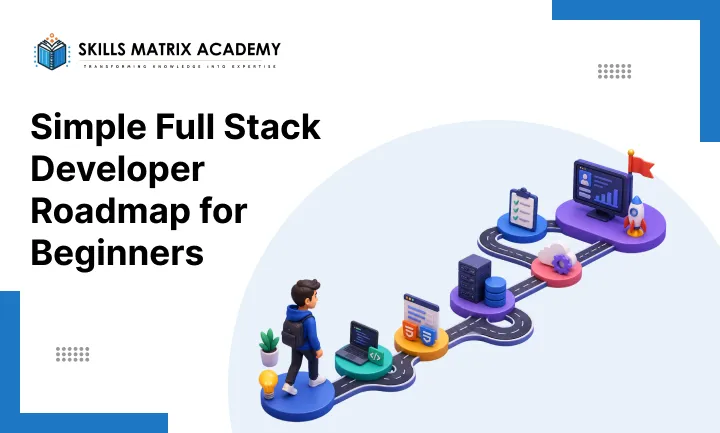
Simple Full Stack Developer Roadmap for Beginners
If you feel overwhelmed, don’t worry. Follow this beginner-friendly web development roadmap.
Month 1-2
Learn:
- HTML
- CSS
- JavaScript basics
Month 3-4
Learn:
- React.js
- Responsive design
- APIs
Month 5-6
Learn:
- Node.js
- Express.js
- MongoDB
Month 7-8
Learn:
- Git
- Deployment
- Docker basics
- Cloud hosting
Month 9+
Build advanced projects and apply for internships.
This roadmap can help you become a job-ready Full Stack Developer in 2026 faster. This full-stack development roadmap for 2026 can help beginners become job-ready faster.
Full Stack Developer Salary in India
The demand for full-stack developers continues to grow rapidly. That’s why full-stack developer salary packages in India are improving every year. Freshers usually start between ₹4-8 LPA.
With experience, salaries can grow much higher. Experienced developers often earn ₹10-20 LPA or more, depending on skills and specialization.
Start Your Full Stack Journey Today
If you want a strong IT career after graduation, this is the right time to start. Focus on practical learning. Build projects regularly. Practice coding consistently. And keep improving your skills.
You can also:
- Attend demo sessions
- Join full-stack developer training programs
- Work on internships
- Build real-world projects
- Improve problem-solving skills
Little daily progress creates huge results over time.
Conclusion
Becoming a full-stack developer in 2026 can open doors to high-paying jobs, freelancing, and long-term career growth. But there’s a catch. You need consistency.
The best developers focus on both frontend and backend development while building practical projects. That’s the real secret behind successful full-stack development.
By learning frontend development skills, backend technologies, database management, APIs, Git version control, and deployment basics, you can build a successful full-stack developer career.
The demand for full-stack developers in India continues to grow rapidly.
And companies are actively searching for developers who can manage complete applications efficiently.
Start learning today. Build projects consistently. And take the first step toward becoming a successful full-stack developer.
Frequently Asked Questions
01. What is full-stack development?
Full-stack development means building both the frontend and backend of a web application.
02. Which language is best for full-stack development?
JavaScript is one of the best choices because it works for both frontend and backend development.
03. How long does it take to become a full-stack developer?
Most beginners become job-ready within 6-12 months with consistent practice.
04. Is full-stack development a good career in India?
Yes. Full-stack developer jobs in India continue to grow because businesses need developers who can manage complete applications.
05. Do I need a degree to become a full-stack developer?
No. Many successful developers learned through projects, online courses, internships, and practical experience.

Bharat Arora
12+ years as a web developer, Bharat has worked in the biggest IT companies in the world. He loves to share his experience in web development.


Bharat Arora
12+ years as a web developer, Bharat has worked in the biggest IT companies in the world. He loves to share his experience in web development.