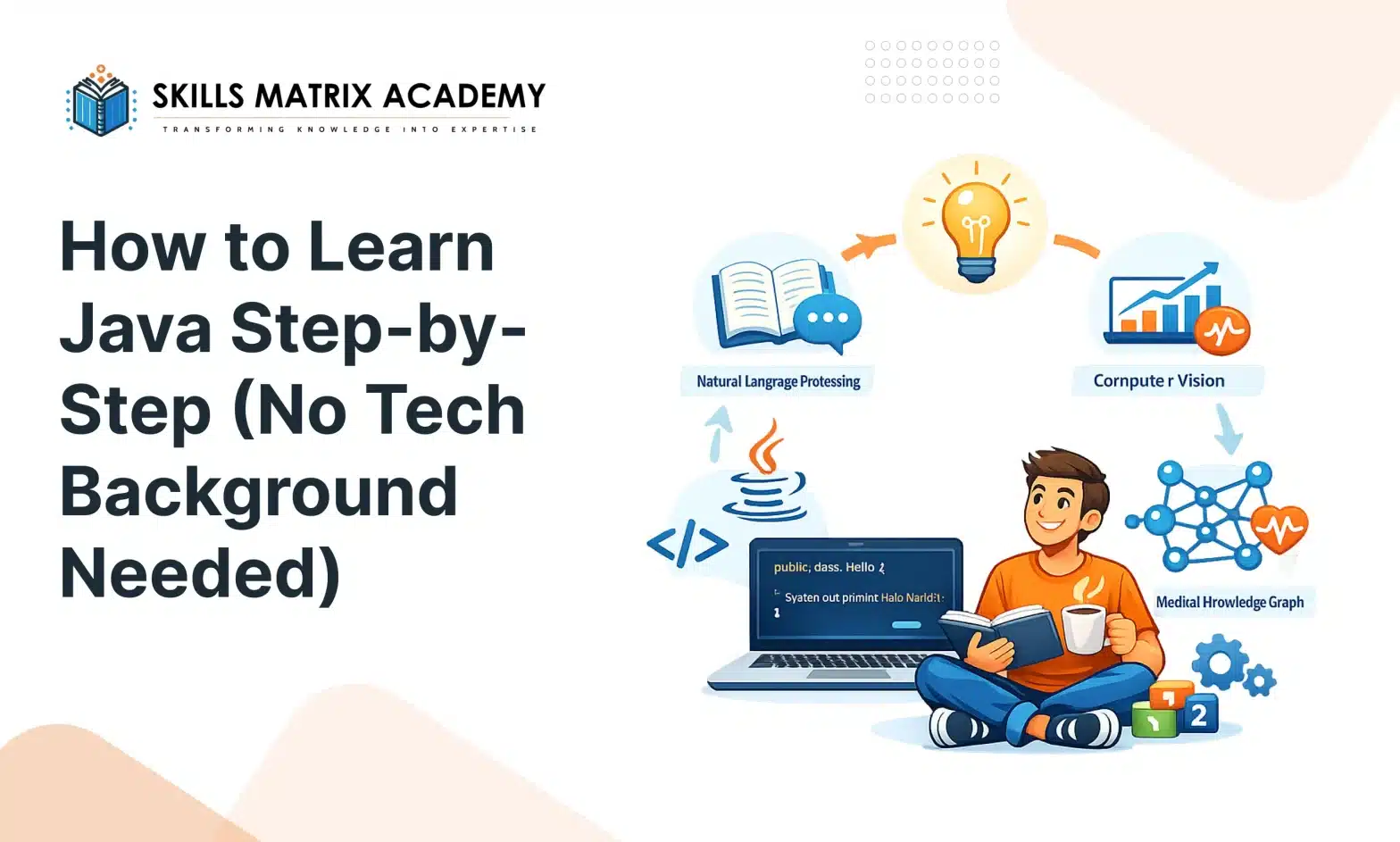
No computer science degree. No prior coding experience. No problem. Here’s how real people learn Java — and actually stick with it.
First, a Quick Story
A few years ago, a guy named Marcus decided he wanted to switch from sales to software development. He had zero technical background. He tried picking up Python, got halfway through a tutorial, then switched to JavaScript, got confused by the syntax, and eventually landed on Java.
He almost quit three times.
But here’s what changed everything for him: he stopped randomly watching tutorials and started following a structured path. Eighteen months later, he landed his first junior developer job.
Marcus isn’t a genius. He just had a plan.
That’s what this guide is — your plan. Whether you’re curious about coding, switching careers, or trying to build that app idea you’ve had for two years, this is a step-by-step walkthrough of how to actually learn Java without losing your mind.
Why Java, Though? (Honest Answer)
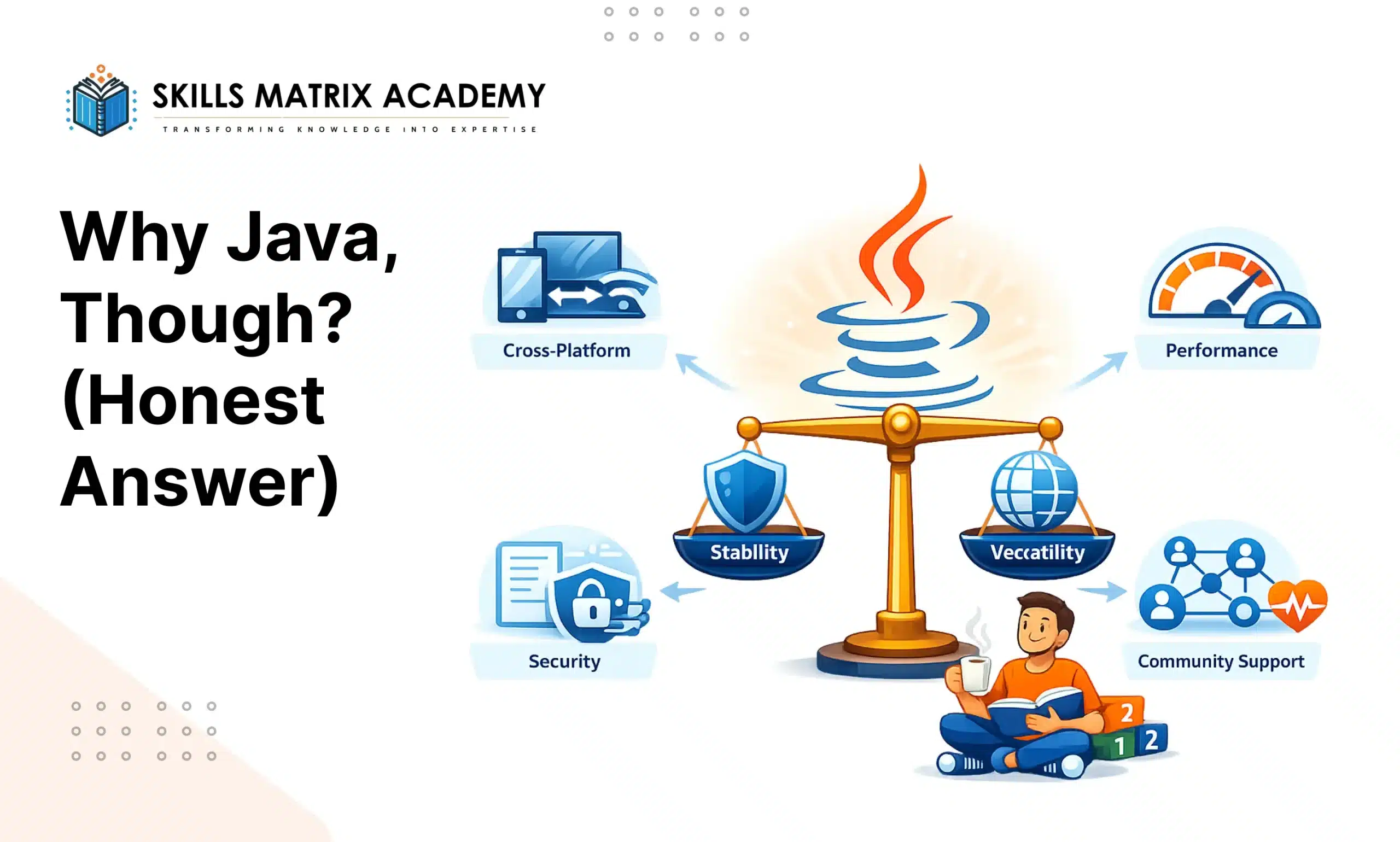
Fair question. There are plenty of languages out there — Python, JavaScript, C++, Go. So why Java?
Think of programming languages like kitchen tools. Python is a sharp chef’s knife — fast, versatile, a favorite for data work and scripting. JavaScript is everywhere, always hot, and great for web stuff. Java? Java is the oven. Reliable, powerful, and used in places where things really need to work — banking systems, hospital software, Android apps, enterprise platforms.
Here’s what makes Java particularly great if you’re starting:
It handles a lot of the messy, complicated stuff automatically. Things like memory management — which trips up beginners in languages like C++ — are largely taken care of for you. That means you can focus on learning to think like a programmer, not wrestling with the machine underneath.
Java is also everywhere. Android runs on it. Massive companies like Amazon, Google, and Uber use it in their back-end systems. It’s been around for nearly 30 years and isn’t going anywhere — in fact, new versions ship every six months, which means the language keeps getting better.
And practically speaking, Java developers get paid well. Salaries regularly clear six figures. That’s not the only reason to learn it, but it’s definitely not a reason.
The Traps That Catch Most Beginners
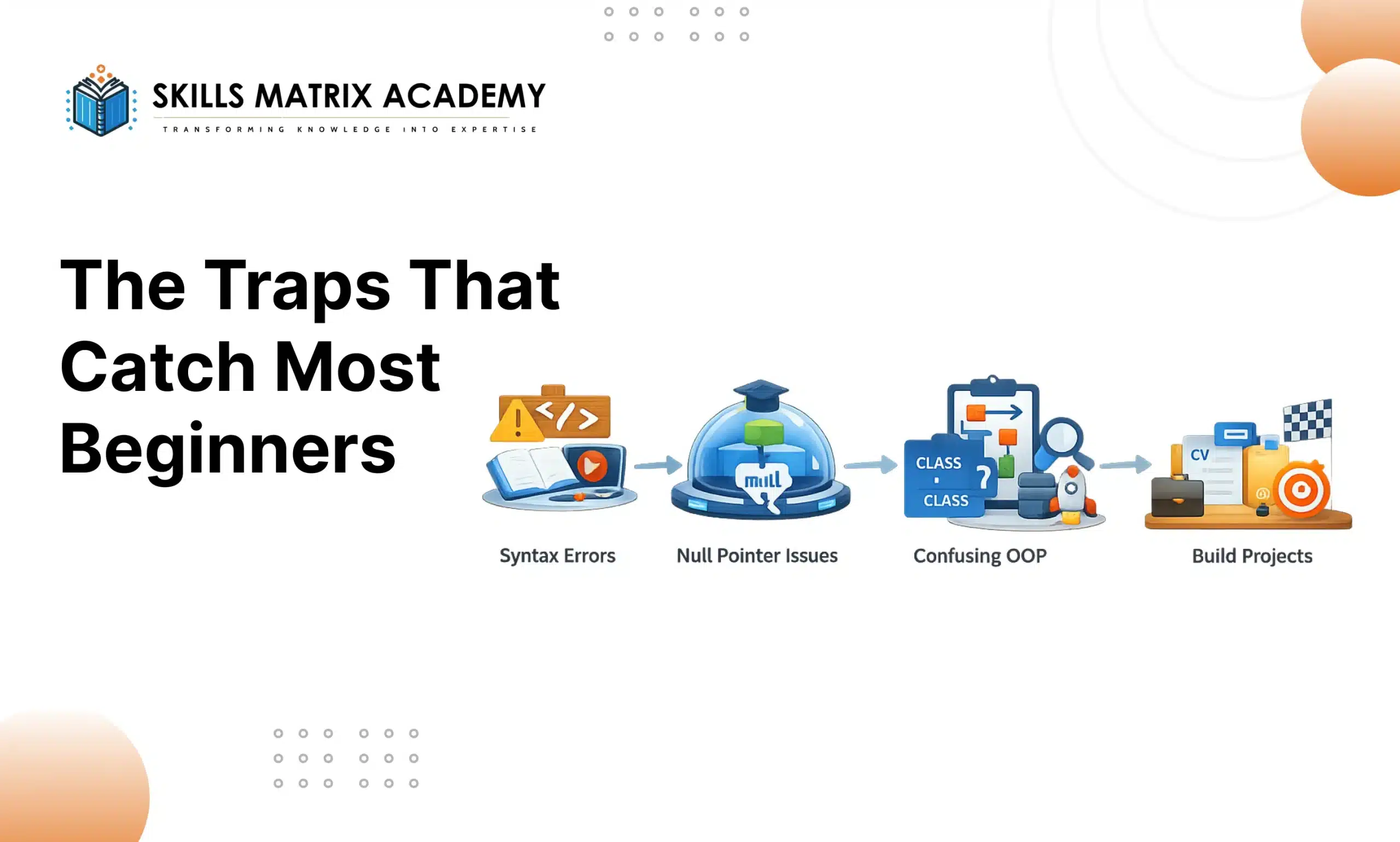
Before we get into the roadmap, let’s talk about the ways people accidentally sabotage themselves. These are painfully common, and knowing them in advance puts you ahead of the curve.
The “I’ll just figure it out” approach. Some people start by randomly Googling things and watching whatever YouTube video shows up first. This works for cooking a new recipe. It does not work for learning a programming language. You end up with a patchwork of half-understood concepts and no idea how they connect. Start with a plan and follow it.
The course-hopper trap. You start a course, get three weeks in, and someone recommends a better one. So you switch. Then a friend mentions a book. You buy it. Every switch resets your momentum. Pick one main resource and commit to finishing it. You can supplement with others, but have a primary path.
Reading without doing. This one kills more beginners than anything else. You can read about how loops work for an hour, understand it perfectly, and then stare at a blank code editor not knowing how to write one. Code is a physical skill. Your fingers need to learn it too. Aim to spend 80% of your time actually writing code — not watching someone else write it.
The binge-then-disappear cycle. Six hours on a Saturday, then nothing for two weeks, is not a learning strategy. Your brain doesn’t retain things that way. Even 30 minutes every single day beats a weekend marathon. Consistency isn’t just helpful — it’s essentially the whole game.
No end goal in mind. “I want to learn Java” is too vague to be motivating. “I want to build an Android to-do app” or “I want a back-end developer job in 18 months” — now that’s a goal. Goals give you direction when you’re confused and momentum when you’re tired.
Your Step-by-Step Java Roadmap
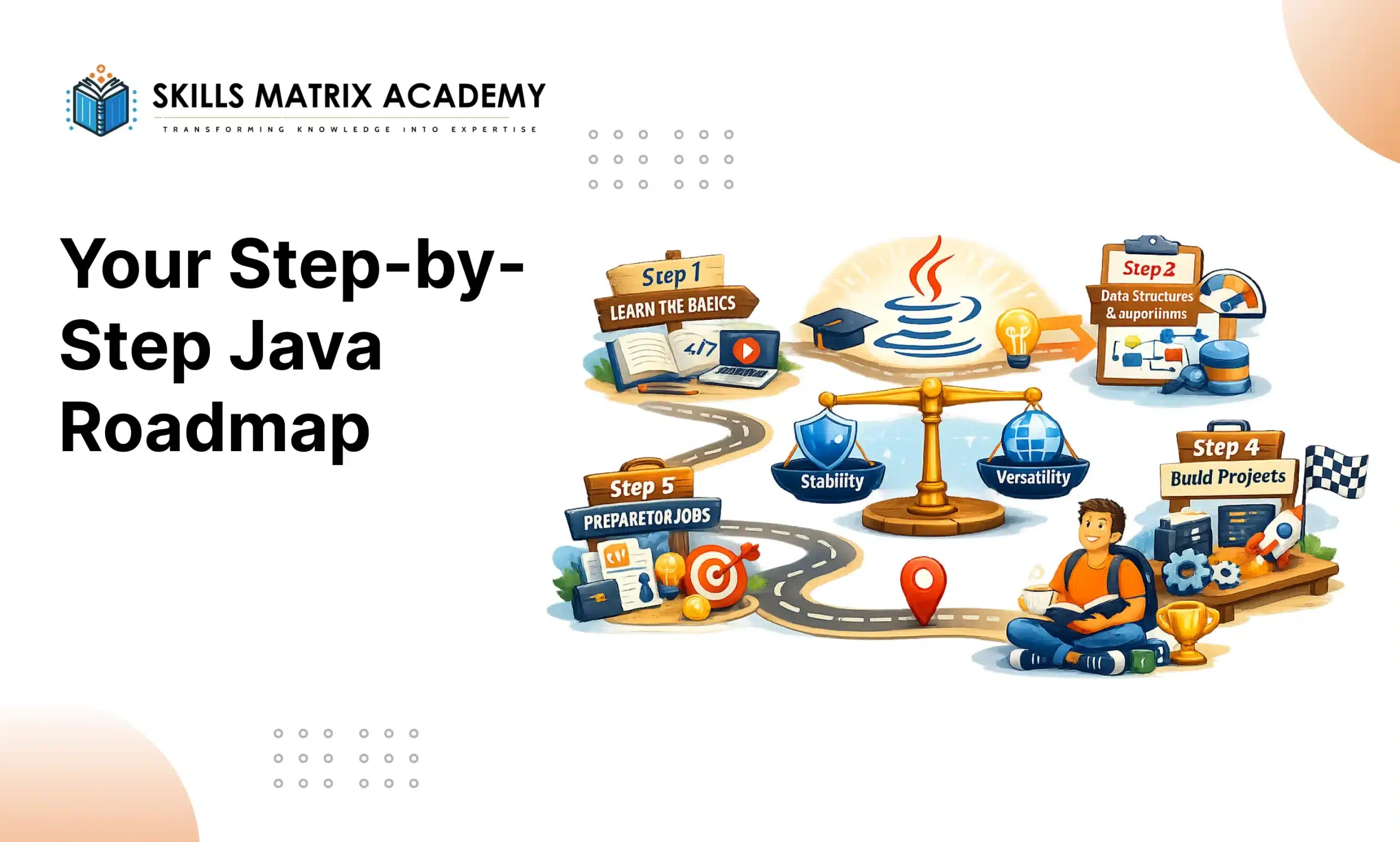
Think of this like a video game with levels. Don’t jump to level 7 without clearing levels 1 through 6 — each stage builds directly on the one before it.
Step 1 — Learn Java Basics & Syntax
Every language has its own grammar. In Java, that means understanding how code is structured, what keywords do, how to store a value in a variable, and how to run a simple program.
Your first real milestone: write a program that prints “Hello, World!” to the screen. Sounds small. It isn’t. It means you’ve installed Java, set up your environment, written actual code, and made it run. That’s a genuine win worth celebrating.
Step 2 — Core Java Concepts
Now you go deeper. Objects, classes, methods, data types — these are the raw materials of every Java program. Think of a class like a blueprint, and an object as the actual thing built from that blueprint. If “Dog” is a class, your golden retriever is an object.
Spend real time here. These concepts show up in literally everything you’ll ever write in Java.
Step 3 — Object-Oriented Programming (OOP)
This is the part people either love right away or find confusing at first — and then love later. OOP is Java’s superpower. It’s a way of organizing code so it mirrors how the real world works: things have properties, behaviors, and relationships.
The four pillars — inheritance, encapsulation, abstraction, and polymorphism — will sound like jargon now. With a few concrete examples (and there are tons of great ones online), they’ll click fast.
Step 4 — Java Collections
At some point, you’ll need to store and organize groups of data. That’s what collections are for — lists, sets, maps, and queues. Think of them as different types of containers. A list keeps things in order. A set doesn’t allow duplicates. A map pairs keys with values, like a real dictionary.
You’ll use collections constantly in real projects. Get comfortable with them.
Step 5 — Exceptions and File Handling
Real programs break. A file doesn’t exist. A user enters bad data. A network connection drops. Java has a system for handling these moments gracefully — so your program doesn’t just crash and leave someone staring at an error screen.
You’ll also learn how to read and write files, which is how most applications interact with the world outside your code.
Step 6 — Algorithms and Design Patterns
This is where you go from “I can write code” to “I can solve problems efficiently.” Algorithms are step-by-step methods for doing things — sorting a list, searching through data, finding the fastest route. Design patterns are proven solutions to common coding problems that experienced developers have figured out over decades.
This step also dramatically improves your performance in job interviews, where algorithm questions are standard.
Step 7 — Multithreading
Modern software does multiple things at once. A music app plays a song while downloading the next. A web server handles thousands of requests simultaneously. Multithreading is how Java manages this. It’s an intermediate topic, but mastering it puts you firmly in professional territory.
Step 8 — Unit Testing
Here’s something beginner courses often skip: professional developers don’t just write code — they test it. Unit testing means writing small checks that verify your code does what you think it does. JUnit is the standard Java tool for this. Learning it makes you more hireable and saves you hours of painful debugging.
Step 9 — Git (Version Control)
Git is how developers save their work, collaborate with teams, and track every change ever made to a codebase. Think of it like “track changes” in a Word document, but for your entire project. Even if you’re working alone, use Git from day one. It’s non-negotiable in any professional environment.
Once you’ve cleared all nine stages, you can branch into whatever matches your goal: Spring Boot for web apps, Android SDK for mobile, Hibernate for databases, or deeper testing frameworks if you’re headed toward QA engineering.
The Best Resources, Honestly Evaluated

You’ve got the roadmap. Now you need the right vehicle. Here are the resources actually worth your time.
For Guided, Structured Learning
JetBrains Academy is one of the strongest options right now. Instead of drilling abstract exercises, you build real things from the start — chatbots, games, simulators. It also teaches you IntelliJ IDEA, the IDE most professional Java developers use every day. That real-world tooling experience matters more than most beginners realize.
The University of Helsinki’s free Java course is a hidden gem. It’s rigorous (the same material as their in-person university classes), completely free, and designed for people starting from scratch. Two parts, roughly 10–20 hours each, and a certificate at the end. Hard to beat.
FreeCodeCamp and Codecademy are great for absolute beginners who want a gentle on-ramp. Interactive, friendly, good for building early confidence before jumping into something heavier.
CodeGym is worth mentioning for the “learn by doing” crowd. It’s built around over 1,200 practical coding tasks — essentially a gym for your Java muscles — with a virtual mentor that checks your code and explains what went wrong. If you need immediate feedback to stay motivated, this is the one.
For People Who Learn Better from Books
Head First Java is one of the most genuinely fun technical books ever written. It uses visuals, puzzles, and mini-stories to explain concepts — unusual for a programming book, and extremely effective for retention. The 3rd edition covers modern Java, so it’s current and relevant.
Think Java is the book for people who want to understand the why behind everything, not just the how. It builds real computational thinking skills, not just syntax knowledge. Widely used in university intro courses.
Java: A Beginner’s Guide by Herbert Schildt is the all-in-one option—it takes you from “what is a variable” through multithreading, generics, and lambda expressions. Solid from cover to cover.
For Finding Your People
Learning to code alone is hard. Learning alongside others is how most people actually finish.
Foojay.io is a Java-focused developer community that welcomes beginners. They have curated starter resources and a culture that doesn’t make you feel dumb for asking beginner questions.
Baeldung.com is the best Java learning blog on the internet — practical, clear, and consistently up to date. Bookmark it now.
Java User Groups (JUGs) are local communities of Java developers that meet to share knowledge and mentor newcomers. Check if one exists in your city. If not, many groups host online meetups and podcasts you can follow from anywhere.
YouTube: Mosh Hamedani’s Java beginner tutorial is one of the clearest introductions you’ll find anywhere. Start there if you’re a visual learner.
For Practice (Don’t Skip This)
Once you’ve got the fundamentals, you need to use them or lose them. Platforms like Codewars, HackerRank, and CodinGame offer Java challenges at every difficulty level. They’re competitive in a fun way and push you to solve real problems under constraints.
For more focused skill-building, Exercism offers short, targeted exercises focused on specific areas, with optional mentor feedback. Think of it as drills before the big game.
Build Something. Anything.
Here’s a truth every developer learns eventually: you don’t really understand code until you’ve built something with it.
Start absurdly small. A number-guessing game. A basic calculator. A program that counts down to your birthday. It genuinely does not matter what you build — what matters is that you run into real problems and have to figure them out yourself. That’s where the actual learning happens. Not in the tutorial. In the frustration of “why isn’t this working,” and the satisfaction of finally making it work.
Once you’re comfortable, step it up. A cinema seat-booking system. A simple chatbot. A Battleship game you can play with a friend. Each project stretches you in new directions, and each stretch sticks.
How Long Will This Actually Take?
Honestly? With a structured plan and consistent daily practice, most people reach junior developer level in 12 to 18 months. That number shrinks if you already know another language or put in more hours per day. It stretches if life gets busy — which it always does.
The most important variable isn’t how fast you are. It’s how consistent you are. Thirty minutes every day for a year beats a weekend sprint every few months. That’s just how skill-building works for most people, and there’s no hack around it.
One Last Thing Before You Close This Tab
The most common reason people don’t learn Java isn’t that it’s too hard. It’s that they keep waiting to feel ready and to finish this project first, or to get through the holidays, or to find a better course, or to get more organized.
You won’t feel ready. Nobody does at the start. Start anyway.
Pick one course from this list right now. Download IntelliJ IDEA’s free Community Edition tonight. Write “Hello, World!” before you go to sleep. That’s literally it — that’s step one, and it takes about 20 minutes.
The path from there is long, genuinely satisfying, and absolutely learnable — even if you’ve never written a single line of code in your life.
Marcus figured it out. So can you.
Learning Java and have a question? Already on the journey and want to share how it’s going? Drop it in the comments — this community is better when we learn together.

Bharat Arora
12+ years as a web developer, Bharat has worked in the biggest IT companies in the world. He loves to share his experience in web development.

Bharat Arora
12+ years as a web developer, Bharat has worked in the biggest IT companies in the world. He loves to share his experience in web development.