Most founders building a SaaS product think first about one thing: speed. Get it live. Get users. Figure out the rest later.
That works — until around month 18, when the platform slows down, the cloud bill doubles, and someone says the words nobody wants to hear: “We might need to re-architect.”
That’s not a technical problem. That’s a strategic one. And it started the moment the stack was chosen, without considering year three.
This guide walks through the best tech stacks for SaaS in 2026, how to match architecture to your business goals, what it actually costs, and how to build something that doesn’t fall apart when growth finally arrives.
Why Your SaaS Tech Stack Is Really a Business Decision
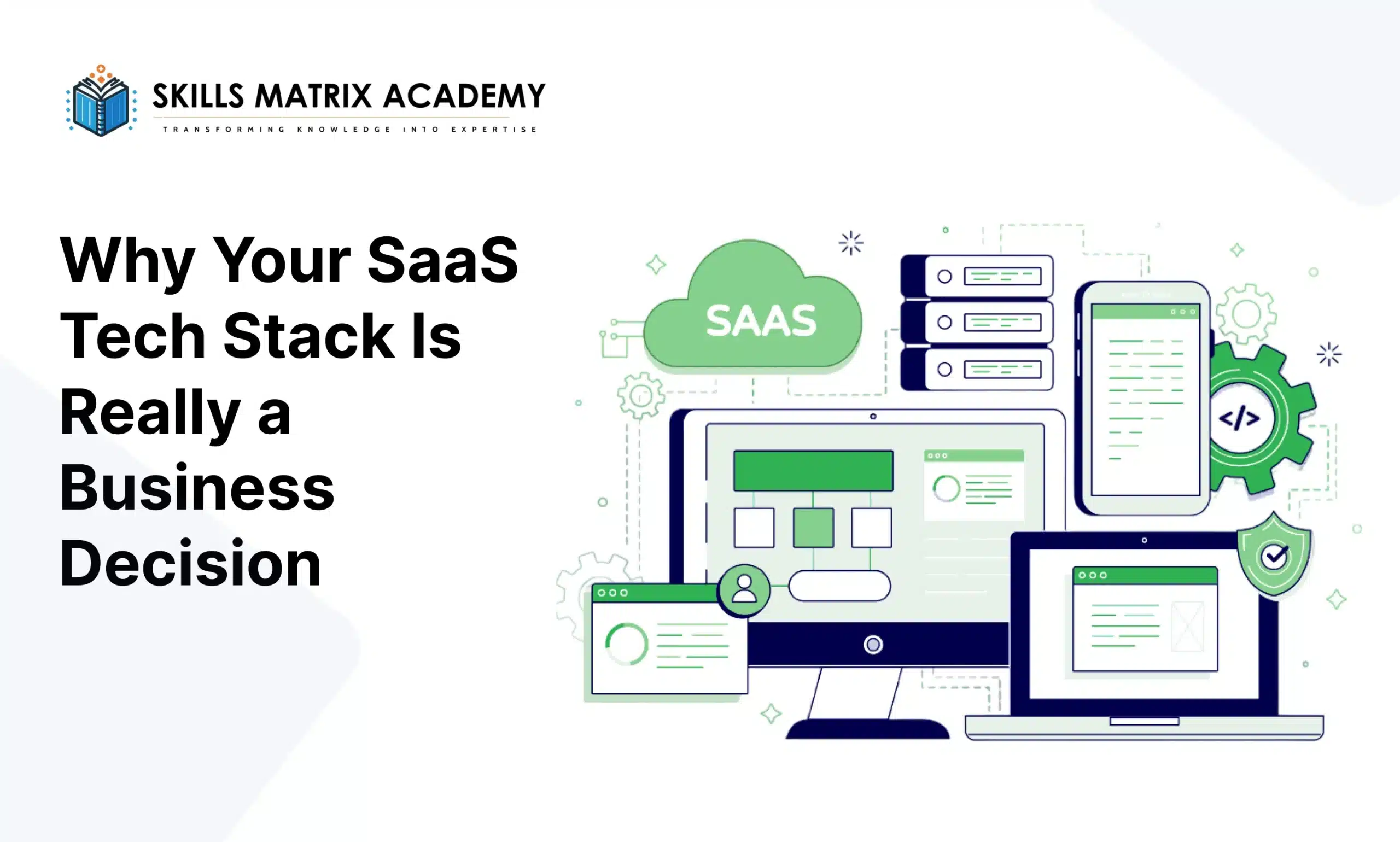
The SaaS tech stack landscape in 2026 is different from even three years ago. The global SaaS market is projected to reach around $375 billion this year and grow to $1.5 trillion by 2034. In that environment, investors aren’t just asking about your growth rate — they’re asking about your architecture.
The wrong SaaS development tech stack looks cheap in year one. But the hidden costs compound fast. Escalating infrastructure bills. Performance problems during traffic spikes. Security gaps that kill enterprise deals. A hiring market where nobody wants to work with niche technology. And eventually, a complete re-architecture — which costs far more than building it right the first time.
A SaaS development guide 2026 worth following starts here: evaluate the total cost of ownership, not just launch cost.
What Actually Goes Into a SaaS Tech Stack?
A SaaS development tech stack covers every layer your product runs on — the frontend users interact with, the backend that handles business logic, the database that stores everything, the cloud infrastructure that keeps it running, and the DevOps tools that automate deployment. Each layer affects the others. These aren’t isolated decisions — they’re an ecosystem.
What Are the Best Tech Stacks for SaaS Startups in 2026?
MERN Stack: Fast, Flexible, and Widely Loved
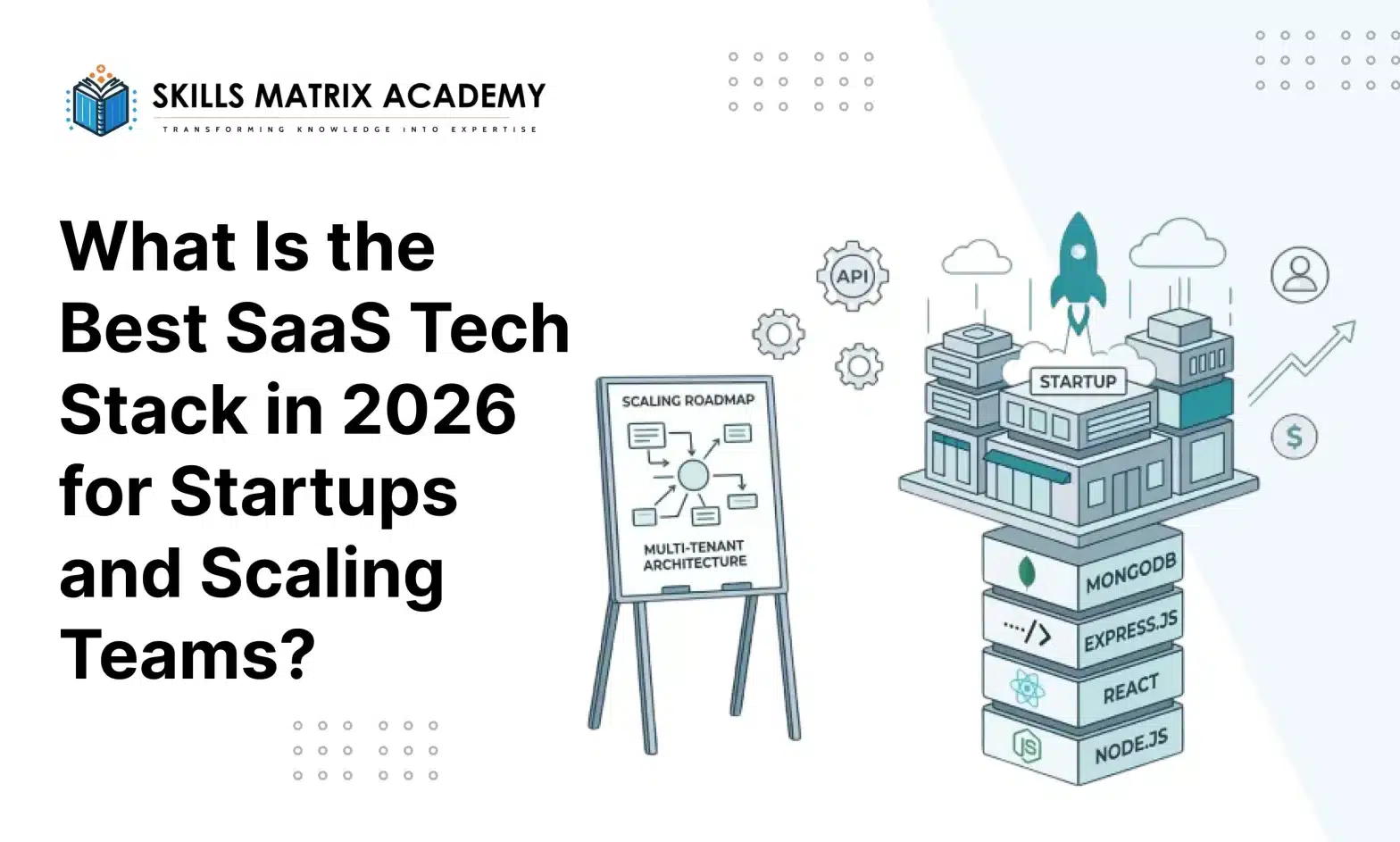
The MERN stack SaaS combination — MongoDB, Express.js, React, and Node.js — remains one of the most popular choices for SaaS startups, and the reasons are practical. It runs entirely on JavaScript across every layer, so developers can work across the full product without switching languages or mental models. The ecosystem is massive. Hiring is straightforward. And teams can ship features quickly without needing specialists at every layer.
MERN stack SaaS works especially well for early-stage products with flexible data models and teams that need to move fast. The main watch-out is MongoDB’s flexibility becoming a liability as data relationships grow complex. Products that eventually need strong relational data integrity — billing systems, permissions, multi-tenant isolation — often wish they’d started with PostgreSQL.
MEAN Stack: Structure for Enterprise Platforms
MEAN stack SaaS swaps React for Angular, bringing a more opinionated, TypeScript-first approach. Angular is a complete framework with built-in routing, state management, and dependency injection — more setup upfront, but significantly more consistency across large codebases. For enterprise SaaS platforms where many developers are touching the same CodeCode, that consistency is genuinely valuable. The tradeoff is hiring depth: React developers are far more abundant than Angular specialists.
Next.js + Node.js + PostgreSQL: The Modern Standard
This stack is quickly becoming the default for modern SaaS stack development, and it’s easy to see why. Next.js SaaS stack brings server-side rendering built directly into the frontend framework — faster load times, better SEO, and more predictable performance. The Node.js SaaS backend cleanly handles API logic. And PostgreSQL SaaS database provides the relational consistency, complex query support, and data integrity that serious SaaS products need as they mature.
This combination suits SaaS products that need strong SEO, will sell to enterprise customers, have complex relational data, or expect to grow a larger engineering team. It’s also well-supported in the hiring market — React developers pick up Next.js quickly, and PostgreSQL is one of the most respected databases in the industry.
Python Stack: The AI SaaS Default
If your product involves machine learning, intelligent automation, or data processing, Python SaaS development isn’t just a good choice — it’s the obvious one. The major AI libraries — TensorFlow, PyTorch, scikit-learn — are all Python-first. There’s no realistic alternative ecosystem at this level of maturity.
Django SaaS development suits teams that want a full-featured, batteries-included backend with strong conventions and built-in admin tools. FastAPI SaaS is the better choice when you need async performance for high-concurrency AI inference workloads. Both pair naturally with a React or Vue frontend, keeping the AI-heavy backend decoupled from the user interface.
Serverless Architecture: The Low-Overhead MVP Option
Serverless SaaS architecture has matured into a genuinely compelling option for early-stage products. The setup — AWS Lambda SaaS, API Gateway SaaS, DynamoDB SaaS, and a React frontend — requires almost no operational management. You pay only for actual usage. Scaling is automatic.
The limitations are real, though. Cold start latency affects first-request performance. Sustained high load can make serverless more expensive than reserved compute. And complex business logic gets awkward when fragmented across many small functions. Serverless is ideal for SaaS MVP development where traffic is unpredictable and operational simplicity matters most.
What Scalable SaaS Infrastructure Actually Looks Like
Individual technologies matter, but in practice, SaaS architecture in 2026 is about how layers work together under pressure.
A modern, scalable SaaS tech stack typically starts with a React or Next.js frontend served through a CDN — static assets cached globally, reducing latency and server load. Behind it sits a Node.js SaaS backend running in Docker containers. SaaS containerization, Docker is standard because containers make deployments portable, consistent, and repeatable across environments.
Kubernetes SaaS deployment handles orchestration — managing containers, scaling during traffic spikes, restarting failures, and rolling out updates without downtime. The database layer pairs a PostgreSQL SaaS database with read replicas, and a Redis caching SaaS layer serves frequent queries without hitting the database. Prometheus SaaS monitoring collects real-time metrics across every layer, giving teams visibility into performance and error rates before users notice problems.
This structure supports horizontal scaling without disruptive re-architecture.
The Architecture Patterns That Matter Most
API-First Architecture
API-first SaaS architecture means that every feature and data object is accessible through a well-defined API before the frontend is built on top of it. This sounds like extra work upfront — it pays off every time you need to integrate a third-party tool, build a mobile app, or let customers connect their own systems. SaaS API integration becomes natural rather than painful.
Microservices vs. Monolith
Microservices architecture SaaS breaks the application into independent services — authentication, billing, notifications — each deployable separately. The advantage is targeted scaling and isolated failures. The cost is operational complexity. For most early-stage teams, starting with a well-structured monolith and extracting services only when there’s a clear reason is the more pragmatic path.
Multi-Tenant Architecture
Multi-tenant SaaS architecture — multiple customers sharing infrastructure with fully isolated data — is what makes SaaS unit economics work. Getting this right early matters. A poorly designed multi-tenant system can leak data between customers or require per-tenant customization, destroying margins at scale.
CI/CD for Continuous Velocity
CI/CD for SaaS is mandatory in 2026. Your customers expect fast iteration. A proper pipeline automatically tests every change, builds deployment artifacts, and ships to production without manual steps. Teams with solid CI/CD ship faster and break things less.
The Real Cost of Stack Decisions
SaaS compute cost optimization starts with your backend architecture. Containerized workloads on managed Kubernetes are efficient but have baseline costs. Serverless is cheap at low volume but expensive under sustained load. Knowing your traffic patterns before committing saves significant money.
SaaS data storage cost depends on your database choices, backup policies, and replication strategy. The costs that surprise teams are usually around data transfer — moving data between services, regions, or to users can add up faster than expected. SaaS network costs from microservices are among the most commonly underestimated line items.
SaaS auto-scaling strategies require careful configuration. Auto-scaling protects performance during traffic spikes, but misconfigured thresholds trigger unnecessary infrastructure expansion — you’re paying for capacity you never used. Setting intelligent scaling policies based on real traffic data is a straightforward optimization that meaningfully reduces monthly bills.
On the people side, SaaS developer hiring trends in 2026 continue to favor React, TypeScript, Node.js, and Python. These ecosystems have the largest talent pools. Building on technologies where the hiring market is thin creates key-person risk and increases recruiting costs — both real business problems, not just engineering concerns.
How to Future-Proof Your SaaS Platform
SaaS future-proof architecture isn’t about predicting every technology shift. It’s about designing for flexibility so evolution doesn’t require rebuilding.
Loose coupling between services means that when one component needs to change — because requirements shift or a vendor changes pricing — you can modify that component without cascading changes everywhere. Infrastructure as Code, using tools like Terraform, defines cloud resources in version-controlled files, making environments reproducible and disaster recovery faster.
Avoiding deep vendor lock-in preserves negotiating leverage. SaaS cloud computing vendors compete for your business, but only if switching is theoretically possible. Building portability from the start is a business hedge, not just a technical preference.
SaaS security best practices — authentication done right, data encrypted in transit and at rest, proper audit logging — need to be built in from day one. SaaS security compliance is what enterprise buyers check first. A gap here doesn’t just create risk — it kills deals.
Choosing the Right Stack for Your Stage
The best SaaS startup tech stack depends on where you are right now.At the MVP stage, MERN or serverless gives you the fastest path to user feedback. You’re optimizing for learning. At the growth stage, Next.js + Node.js + PostgreSQL — or Python if AI is core to the product — gives the right balance of performance, maintainability, and hiring depth. At the enterprise stage, SaaS platform architecture choices directly affect your ability to close deals. Compliance, data isolation, and audit capabilities become non-negotiables that buyers check before signing.
Frequently Asked Questions
What is the best tech stack for SaaS in 2026?
It depends on your product type and stage. MERN (MongoDB, Express.js, React.js, and Node.js) and Next.js + Node.js + PostgreSQL are the most popular general-purpose options. Python stacks are the standard for AI-driven SaaS. Serverless works well for MVPs with unpredictable traffic.
How does the tech stack affect SaaS scalability?
Your SaaS platform scaling capability is directly tied to architecture choices. Containerized backends, read replicas, CDN-served frontends, and caching layers all contribute to a system that handles growth without emergency re-engineering.
Is PostgreSQL or MongoDB better for SaaS?
A PostgreSQL SaaS database is better suited to mature products with complex relational data, billing, and compliance requirements. MongoDB SaaS database suits early-stage products with flexible, document-centric data models.
How do you future-proof a SaaS architecture?
Build API-first, keep services loosely coupled, use Infrastructure as Code, avoid vendor lock-in, and instrument observability from day one. These principles keep your system adaptable as your business evolves.

Bharat Arora
12+ years as a web developer, Bharat has worked in the biggest IT companies in the world. He loves to share his experience in web development.


Bharat Arora
12+ years as a web developer, Bharat has worked in the biggest IT companies in the world. He loves to share his experience in web development.