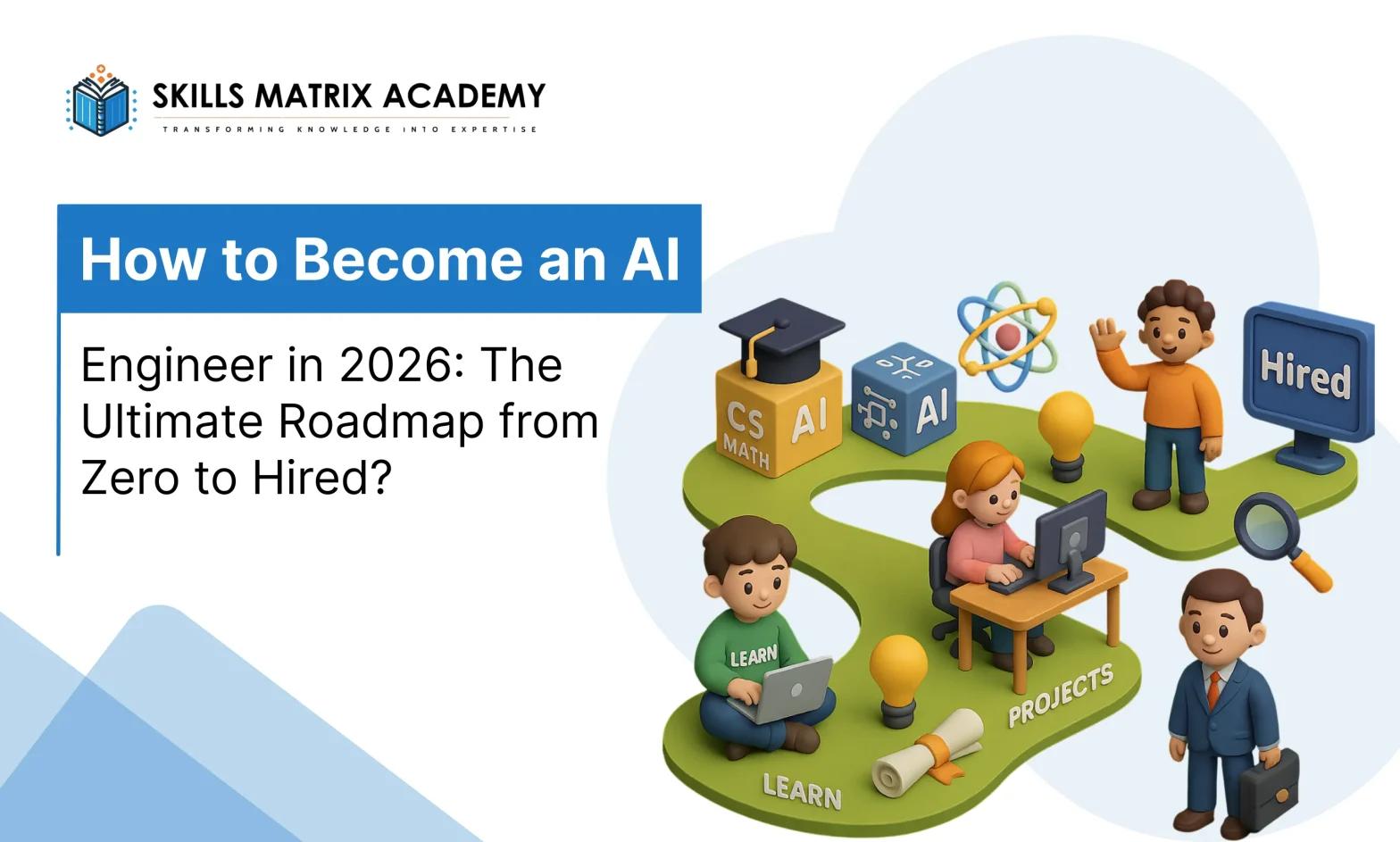
AI engineering is the hottest career path on the planet right now. It is not just about hype. It is about building things that actually work. Companies are desperate for people who can turn raw models into powerful tools. They need builders.
In this guide, I will show you exactly how to become an AI engineer. We will cover the skills, the projects, and the massive paychecks waiting for you. This is the only AI engineering roadmap 2026 you will ever need.
What is AI Engineering?
Most people think you need a PhD to work in AI. That is a myth. Artificial intelligence engineering is different from research. Researchers invent new models. Engineers use those models to solve real-world problems.
As an AI engineer, you build the “glue” that makes AI useful. You create large language model applications, design RAG pipelines, and build autonomous AI agents. You are basically a software engineer with a very powerful new toolkit.
AI Engineer Salary 2026: The Numbers
The money in this field is incredible. Whether you are looking for AI jobs in India or worldwide, demand is driving salaries through the roof. Here is what the AI engineer salary 2026 looks like:
AI Engineer Salary India:
- AI engineer fresher salary: ₹5 – 15 LPA (Tier 1)
- AI engineer mid-level salary: ₹15 – 40 LPA (Tier 1)
- Senior AI engineer salary / LLM engineer salary: ₹50+ LPA (Tier 1)
Global AI Engineer Salary:
- Annual Pay: $120,000 – $250,000+
- Remote AI jobs: These roles are growing faster than any other category.
What Do AI Engineers Actually Build?
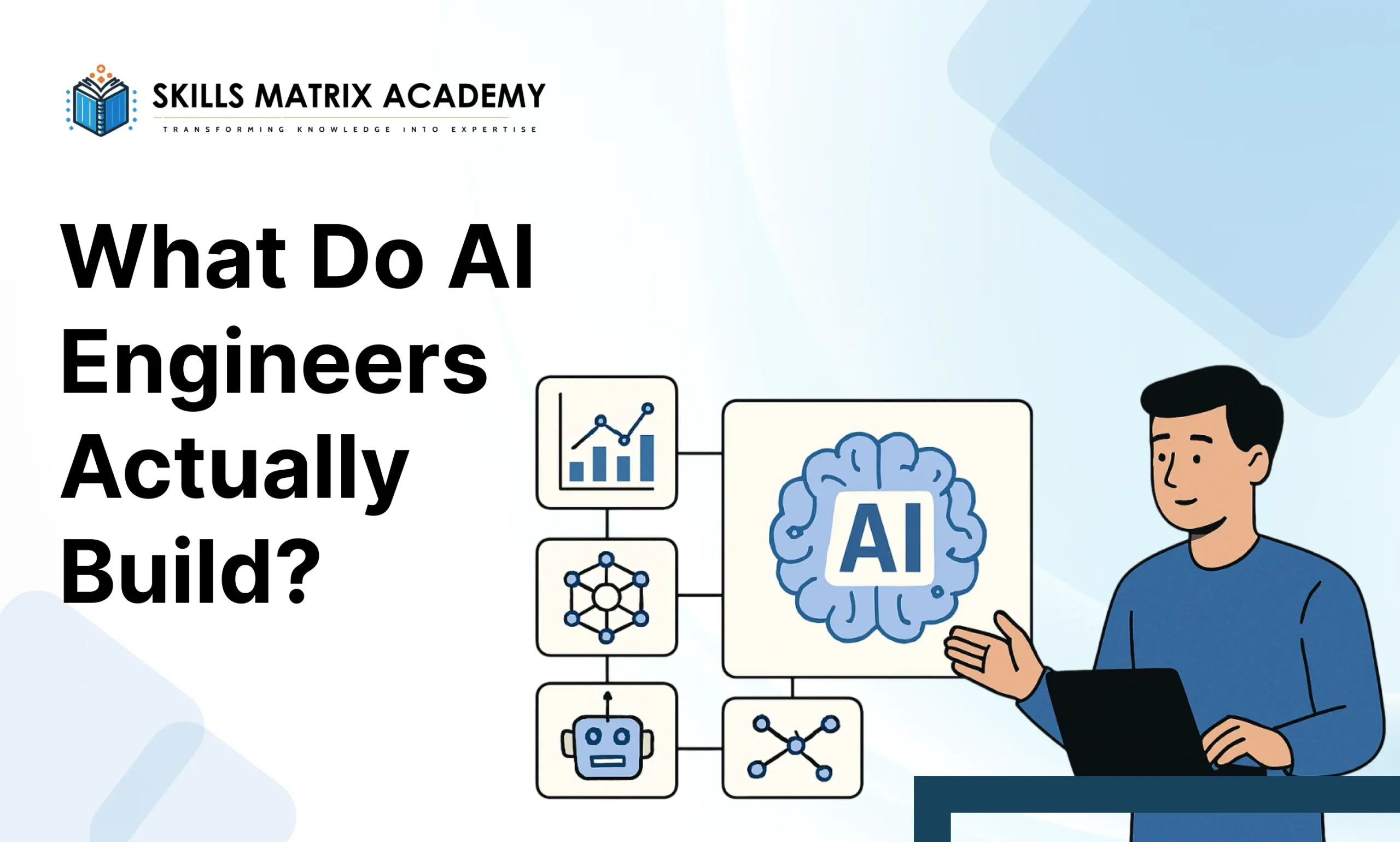
Before you start your AI engineer learning path, you should know what the daily job looks like. AI engineer roles and responsibilities involve more than just writing prompts. You are building systems.
- Chatbot development using AI: You build smart assistants that actually understand context. You might become a specialized AI chatbot developer.
- RAG system development: You give AI a “memory” by connecting it to private company data.
- Agentic AI systems: You build autonomous AI agents that can plan tasks and use tools without help.
- AI infrastructure: You build the systems that keep these apps running smoothly and safely.
The future of AI careers belongs to those who can bridge the gap between a raw model and a finished product. Let’s dive into the step-by-step AI engineer roadmap.
Step 1: Master Programming Fundamentals
You cannot skip this. You must learn to code before you touch a neural network. Programming fundamentals for AI start with one language: Python.
Python for AI engineering is the industry standard. Almost every AI engineering tool is built first for Python. You need to master variables, loops, and data structures. You also need to learn Object-Oriented Programming (OOP). This is how you build clean, reusable code.
While you learn Python, you must learn version control for AI engineers. This means Git and GitHub for developers. Every project you write should live on GitHub. It shows employers that you know how to manage code like a professional.
Beginner AI Projects to Start
Try building these to build muscle memory:
- A command-line todo list.
- A simple web scraper.
- A budget tracker.
- An automatic file organizer.
These AI project ideas help you understand how to handle data. If you want to be a Python AI developer, you need to be comfortable failing and fixing your code. Spend at least two months here.
Step 2: Software Engineering Essentials
This is where many people fail. They learn AI but forget the “engineering” part. Software engineering for AI is what makes your apps reliable. You need to know how the web works.
Focus on backend development for AI. You should learn how to build APIs using FastAPI for AI or Flask for AI. These frameworks enable your AI model to communicate with the rest of the world. REST API development is a core skill here.
You also need to understand database fundamentals for AI. Your AI needs to store and retrieve information. Learn about SQL and NoSQL databases. Then, learn containerization for AI apps using Docker for AI. Docker ensures your app runs the same way on your computer as it does in the cloud.
Testing and Reliability
Testing AI applications is different from testing regular code. AI can be unpredictable. You need to learn Pytest for AI and test-driven development. Write tests that verify your API returns the correct data. This prevents your app from breaking when you make changes.
Step 3: LLM Fundamentals
Now the fun part begins. You are ready for LLM application development. First, you must understand how LLMs work at a high level. They are pattern-matching engines. They guess the next word based on patterns they’ve learned.
Learn about tokens in LLMs. Tokens are how models read text. If you don’t manage tokens, your bills will be huge. You also need to understand the context window LLM. This is how much “memory” the model has for a single conversation.
Tools and Parameters
Start using the OpenAI, Anthropic, and Google AI APIs. You should also explore open-source LLMs, such as Llama. Learn how to tune AI model parameters such as temperature and top-p. These settings control how “creative” or “focused” the AI is. This is the core of AI API integration.
Step 4: RAG Pipelines and Vector Databases
Standard LLMs have a problem. They only know what they were trained on. They don’t know about your private files. That’s exactly where retrieval-augmented generation (RAG) steps in. RAG pipelines enable an LLM to look up information in real time.
To build a RAG system development project, you need to learn about vector database AI. Vector databases store embeddings for AI. Embeddings are just numbers that represent the meaning of text. This enables semantic search AI, where the computer finds results based on meaning rather than just keywords.
Key RAG Skills:
- Document chunking strategies: How do you break a big PDF into small pieces?
- Semantic retrieval: Finding the right piece of info quickly.
- RAG evaluation metrics: How do you know if the AI is telling the truth?
Mastering enterprise RAG systems is a shortcut to high-paying AI jobs. Companies want to chat with their data safely.
Step 5: Agentic AI and Tool Use
The next frontier is agentic AI systems. An agent doesn’t just respond — it takes action. It can use a calculator, search the web, or send an email. This is done through tool-calling AI (or function-calling LLMs).
You provide the model with a list of tools. The model decides which tool to use. For example, if a user asks for the weather, the agent calls a weather API. This is the heart of intelligent automation.
Building autonomous AI agents requires great error handling. What if the tool fails? What happens if the agent keeps repeating the same steps? Learning AI orchestration frameworks like LangChain or CrewAI will help you manage these AI workflows.
Step 6: Production Systems and LLMOps
Building a prototype is easy. Running a system for thousands of users is hard. This is called LLMOps. You need to focus on deploying AI applications so they don’t crash.
AI monitoring and observability are vital. Use tools like LangSmith monitoring to see exactly what your AI is doing. You also need prompt versioning. Just like you version your code, you must version your prompts.
Production Checklist:
- AI cost management: Track how much you spend on API calls.
- A/B testing AI models: Compare two different models to see which one users prefer.
- AI evaluation frameworks: Use automated scripts to check the quality of AI answers.
- Cloud deployment AI: Learn how to host your apps on AWS, Google Cloud, or Azure.
Step 7: AI Safety and Advanced Topics
As an AI engineer, you have a responsibility. You must learn about responsible AI development. This includes AI safety and AI alignment. You need to protect your apps against prompt-injection prevention attacks. This is when a user tries to “hack” the AI into doing something bad.
Stay updated on bias in AI systems. Models can sometimes be unfair or rude. You need to implement filters to keep things safe. This is part of AI security best practices.
The field of artificial intelligence engineering moves fast. Continuous learning AI is the only way to stay relevant. Follow AI industry trends 2026 and keep building. AI career growth is unlimited for those who remain curious.
How Much Time Does It Take to Become an AI Engineer?
- With a coding background: 6–9 months of focused learning
- Without a coding background: 12–15 months to build a strong foundation
- Working professionals: 1–2 hours a day is enough with a structured plan
Real-World Project Examples
To truly stand out, your portfolio should move beyond basic tutorials. Employers in 2026 look for “system thinkers” who can solve actual business pain points. Here are a few AI engineering projects that prove you are ready for a high-paying AI job:
- RAG-Powered Legal Assistant: Build a system that allows lawyers to upload 100+ page contracts and ask questions like, “What are the termination clauses?” Use a vector database like Pinecone to store your document embeddings.
- Autonomous Customer Support Agent: Create an agentic AI system that doesn’t just chat but actually takes action. For example, an agent that can check an order database, identify a delayed shipment, and automatically draft a refund email for a human to approve.
- YouTube Video Summarizer: Build a tool that uses Whisper for speech-to-text and an LLM to generate structured chapters and key takeaways from long podcasts or lectures.
You don’t need to be a math genius to master artificial intelligence engineering. You need to be a great builder who follows a proven AI engineer roadmap. The future of AI careers is bright, and the door is wide open for those who can turn complex models into useful tools.

Bharat Arora
12+ years as a web developer, Bharat has worked in the biggest IT companies in the world. He loves to share his experience in web development.


Bharat Arora
12+ years as a web developer, Bharat has worked in the biggest IT companies in the world. He loves to share his experience in web development.