Introduction
Every student reaches a point where this question hits hard.
You’re scrolling through LinkedIn, watching people your age land jobs and freelance projects, and you start wondering what you’re missing. Should you be applying for internships? Should you be spending that time learning something online instead?
Everyone around you seems confident about what works. But their answers contradict each other.
Here’s what nobody tells you clearly. Both internships and online skills matter. But the way you combine them, and the order you follow, is what separates people who grow fast from people who stay stuck. This blog will give you that clarity.
Understanding Internships
An internship is often the first time you realize how different real work is from everything you studied.
You walk into an office or join a team remotely, and suddenly nothing works the way it did in theory. Deadlines are real. People have different working styles. Feedback can be blunt. Priorities shift without warning. And you have to figure out how to keep up.
That adjustment is uncomfortable. But it is also incredibly useful.
The importance of internships is not just about adding a line to your resume. It is about developing a kind of awareness that only comes from being inside a working environment. You start understanding how decisions get made, how teams collaborate under pressure, and what it actually means to deliver results for someone else.
What Internships Give You That Nothing Else Can
Internships for freshers carry a specific kind of value. When you have no work history, an internship becomes proof that you can show up, take direction, and get things done in a professional setting. Recruiters know the difference between a candidate who has only studied something and one who has actually worked.
Beyond the resume value, internships build your network in ways that compound over time. The senior colleague who guides you through your first real project, the manager who introduces you to someone in their circle, the teammate who later starts a company and remembers you. These connections come from internships, not certificates.
Understanding Online Skills
Ten years ago, if you wanted to learn a professional skill, you needed to enroll in a course, show up in person, and wait months before you could apply anything. That world is gone.
Today you can learn digital marketing, web development, graphic design, video editing, content writing, or data analysis from your phone. You can find world class instruction for free or close to it. You can move at your own pace and go as deep as you want.
The benefits of online skills are genuinely significant. The biggest one is speed. A person who commits fully to learning one skill online can go from complete beginner to someone with a working portfolio in three to six months. That is a fast track into the job market that previous generations simply did not have access to.
Online skills for career growth also create earning opportunities before you even have a job. Freelancing, remote project work, and consulting are all available to someone who can demonstrate real ability. You do not have to wait for a company to hire you before you start building income.
Why the Demand for Skills Is Only Growing
Companies are hiring differently now. Degrees still matter in many fields but they are no longer the main signal hiring managers rely on. What they want to know is whether you can actually do the job. Career skills for students that are practical and demonstrable have become the fastest way to answer that question with confidence.
Digital skills demand has been climbing steadily across almost every industry. Marketing teams need people who understand content and data. Design and development roles exist in companies that would not have had those positions a decade ago. Knowing the right skills puts you in front of opportunities that most people your age are not even aware of yet.
The Difference That Actually Matters
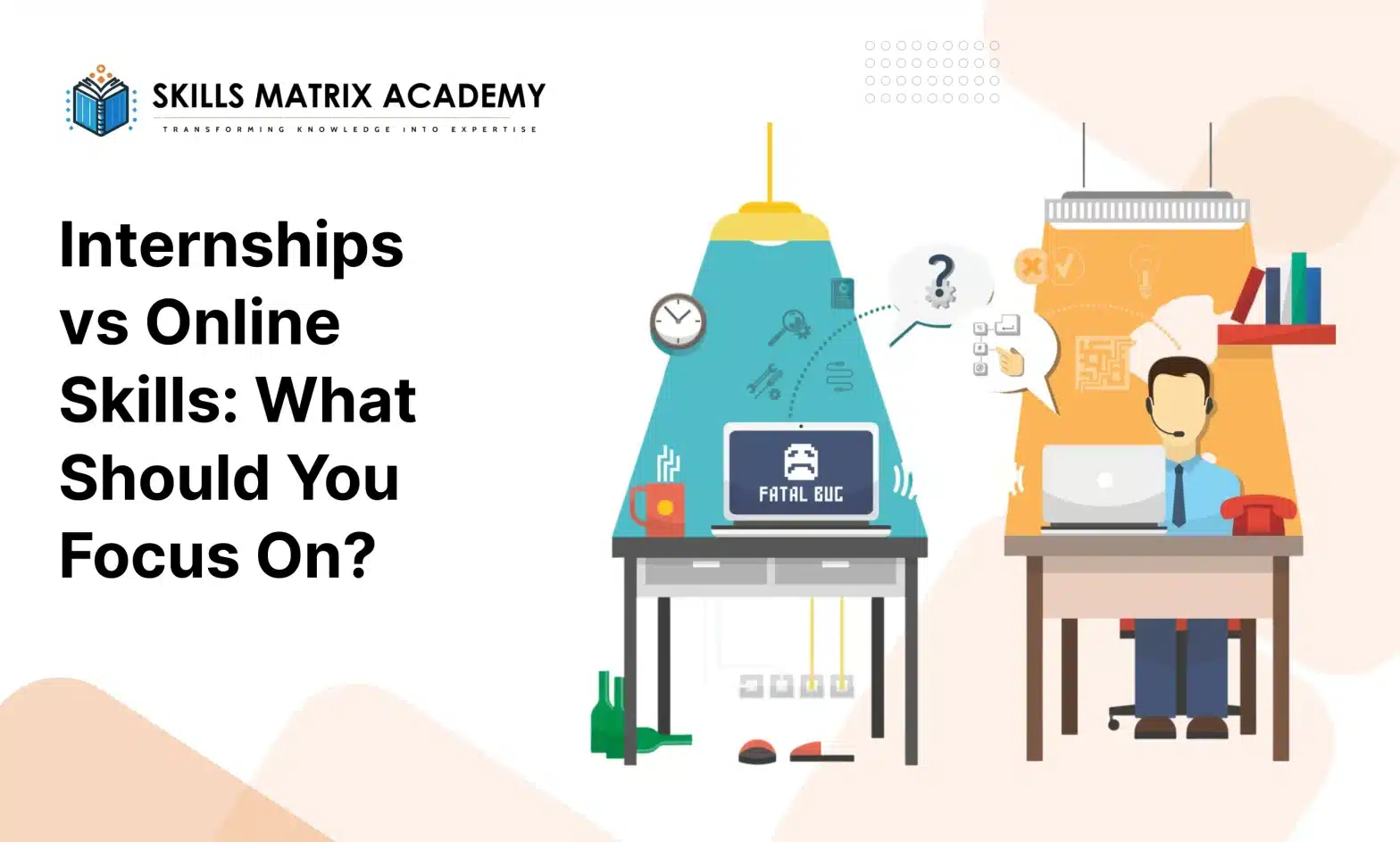
When you strip everything down, internships vs online skills comes to this.
Skills teach you what to do. Internships teach you how real environments work.
One gives you capability. The other gives you context. Trying to build a career with only one of them is harder than it needs to be. Skills without real world exposure can leave you feeling technically prepared but practically uncertain. Internships without skills can leave you doing basic tasks while watching others handle the real work.
Skills vs experience is not a competition. They are two parts of the same process.
The Mistake That Slows Most Students Down
This is worth being direct about because it is an extremely common pattern.
Some students do internship after internship without building any specific skill. They have exposure but not ability. When it comes time to take on real responsibility, they struggle. The internships look good on paper but do not translate into genuine confidence or capability.
Other students spend months collecting course certificates without ever applying anything. They complete module after module but never build a project, never work with a real client, never put themselves in a situation where their skill is tested. Practical learning vs theoretical learning is a real distinction, and staying on the theoretical side for too long creates a gap that is hard to close later.
Both mistakes come from the same place. Treating internships and online skills as separate strategies instead of one connected journey.
A Practical Path That Actually Works
Job ready skills do not appear overnight. They come from following a sequence that builds on itself.
Start with online learning if you are beginning from zero. Choose one area that genuinely interests you and commit to it for a few months. The temptation is to learn five things at once because everything seems useful. Resist that. One skill learned properly is worth more than five skills learned partially.
While you are learning, start building. This is the step most people skip and it is the most important one. Portfolio building for jobs does not happen after you feel ready. It happens while you are becoming ready. Create something real with what you are learning. Write the content, design the graphics, build the small website, run the experiment. Do something that exists outside of your notes app.
Once you have a skill and something to show for it, internships become a completely different experience. You are not just observing anymore. You can contribute. That shifts how people treat you, what tasks you get assigned, and how much you learn in a short amount of time.
When It Makes Sense to Prioritize Internships
Internship vs freelancing is a real decision many students face. If you already have a working foundation in your skill, if you want to understand how a specific industry operates from the inside, or if the job you are targeting specifically values work experience for resume credibility, then going after an internship is the right move at that stage. The key word is stage. Internships are most powerful when they are not your starting point but your next step.
Doing Both at the Same Time
Online skills vs internships for students does not have to be a strict choice. Many people manage both simultaneously and do it well.
The way to make it work is to be realistic about your bandwidth. If you are doing a full time internship, do not try to power through an intense online course at the same pace. Instead, go deeper in one area that connects directly to your internship work. The real world context makes the learning faster and more sticky because you immediately see where it applies.
How to balance internships and online learning really comes down to protecting your focus. Do not let either completely disappear for long stretches. A few weeks of lighter learning during a demanding internship is fine. Months of ignoring skill development is where people start falling behind without realizing it.
A Simple Example That Makes It Clear
Picture two people both trying to break into content marketing.
The first one applies for internships right away with no real skills developed yet. They get a role, spend most of their time on small tasks, watch the experienced team members handle the real work, and finish the internship with a certificate but not much clarity on what they are actually capable of.
The second person spends three months learning SEO basics, content strategy, and writing fundamentals. They start a small blog to practice. They write twenty posts, study what performs and why, and put together a simple portfolio. Then they apply for internships.
The second person gets more interesting work, earns more trust faster, builds stronger relationships with the team, and leaves with both a stronger resume and a clearer sense of their own ability. Best online skills for students in 2026 are not a shortcut around internships. They are what makes internships genuinely worthwhile.
Final Thoughts
The debate around internships vs online skills has a straightforward answer when you look at it honestly.
Build your skills first. Then use internships to test and sharpen those skills in real conditions. Then keep learning. Then keep applying. Student career development that works looks like this cycle repeated over and over with increasing depth each time.
The students who grow fastest are not necessarily the most talented. They are the ones who understood early that skills and experience feed each other, and they stopped waiting for the perfect moment to start either one.
You have the sequence now. The only step left is to start your journey.
FAQs
- Which is better for students, internships or online skills?
Neither is better in isolation. Online skills give you the capability to contribute, and internships give you the environment to apply that capability. You need both, in the right order.
- Should I do an internship or learn skills first?
Learn first. Three to six months of focused skill building will make your internship experience more valuable by a significant margin.
- How to gain experience without an internship?
Build real projects, take on small freelance work, create content, and develop a portfolio. Real output counts as real experience even when it comes from self directed work.
- Do internships matter without skills?
They matter less than most people assume. Without skills to contribute, you end up in a passive role where your growth is limited and your impact is minimal.
- How to become job ready with online skills?
Focus on one skill, build a portfolio that shows real work, and combine that with internship exposure. That combination is what genuinely job ready looks like.

Bharat Arora
12+ years as a web developer, Bharat has worked in the biggest IT companies in the world. He loves to share his experience in web development.

Bharat Arora
12+ years as a web developer, Bharat has worked in the biggest IT companies in the world. He loves to share his experience in web development.