If you are new to programming, you have probably asked this question before:
“Are Java and JavaScript the same thing?”
At first glance, they sound almost identical. Both are popular programming languages. Major tech companies use both. And both play a huge role in software development.
But here’s the deal:
Java and JavaScript are completely different.
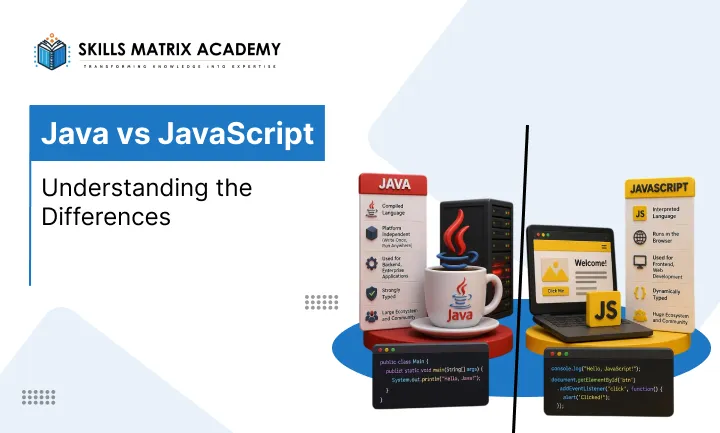
The difference between Java and JavaScript goes far beyond their names. They have different syntax, uses, runtime environments, and career opportunities.
Java is widely used for building backend systems, Android apps, business software, and large applications.
JavaScript is mainly used for websites, interactive interfaces, web applications, and frontend development.
Understanding the differences between Java and JavaScript is important if you want to start a career in programming. Choosing the right language can save you time, help you learn faster, and guide you toward the right career path.
In this guide, you will learn:
- What is Java
- What is JavaScript
- Java vs JavaScript syntax differences
- Java vs JavaScript performance
- Advantages and disadvantages of both
- Real-world use cases
- Which language is better for beginners
- Which language offers better career opportunitie
Let’s dive in.
What Is Java?
Java is a powerful object-oriented programming language created by Sun Microsystems in 1995. It was designed with one major goal:
“Write Once, Run Anywhere.”
In simple terms, Java programs can run on different operating systems without major changes. This happens because Java uses the Java Virtual Machine (JVM).
The Java compiler changes source code into bytecode. The JVM then reads and executes that bytecode. Because of this setup, Java became one of the most trusted programming languages for enterprise-level software.
Today, Java powers:
- Android applications
- Banking software
- Enterprise systems
- Cloud applications
- Desktop software
- Backend systems
- IoT devices
Many global companies still rely heavily on Java. Companies like Netflix, Amazon, Twitter, LinkedIn, and Uber use Java for various backend services.
Key Features of Java
Some important features of Java include:
Platform Independence
Java works across different operating systems. This makes development easier for large businesses.
Object-Oriented Structure
Java follows the principles of object-oriented programming. The four main pillars include:
- Abstraction
- Encapsulation
- Inheritance
- Polymorphism
These principles help developers create organized and reusable code.
Strong Security
Java includes built-in security features. It avoids risky memory access problems that appear in some low-level languages. This makes Java suitable for banking and healthcare applications.
Multithreading Support
Java allows multiple parts of a program to run simultaneously. This improves performance in large systems.
Robust Performance
Java includes strong error-checking mechanisms. That helps developers detect issues early.
What Is JavaScript?
JavaScript is a popular scripting language mainly used for web development. It was created to make websites interactive.
Before JavaScript existed, websites were mostly static. People could only view information, with very little interaction. JavaScript changed everything.
Today, JavaScript powers:
- Interactive websites
- Animations
- Forms
- Real-time updates
- Browser games
- Web applications
- Mobile apps
JavaScript runs directly inside web browsers. Popular browsers such as Chrome, Firefox, Safari, and Edge all run JavaScript.
Unlike Java, JavaScript is usually an interpreted language. That means browsers execute the code instantly without a separate compilation process.
Key Features of JavaScript
Some important features of JavaScript include:
Dynamic Typing
JavaScript variables do not require strict type declarations. This makes coding faster and more flexible.
DOM Manipulation
JavaScript can directly change website content. It controls buttons, menus, animations, and forms.
Event-Driven Programming
JavaScript reacts to user actions. For example:
- Mouse clicks
- Keyboard typing
- Form submissions
- Scrolling
Cross-Platform Support
JavaScript works on almost every device with a browser. That includes:
- Computers
- Smartphones
- Tablets
- Smart TVs
Fast Development
JavaScript allows developers to see results instantly. This speeds up development.
Java vs JavaScript: The Main Difference
Here is the simplest explanation of Java vs JavaScript:
Java is mainly used for backend systems, Android apps, and enterprise software.
JavaScript is mainly used for websites and interactive web applications.
That is the biggest difference between Java and JavaScript.
But there’s more. Java and JavaScript also differ in:
- Syntax
- Performance
- Runtime environments
- Typing systems
- Use cases
- Career opportunities
Now let’s break each area down.
01. Java vs JavaScript Syntax
One of the first things beginners notice is the syntax difference.
Java Syntax
Java is a statically typed language. Developers must clearly define data types.
Example:
String name = “John”;
int age = 25;
Java syntax is strict. This structure helps reduce coding mistakes. Large companies prefer this because it improves maintainability.
JavaScript Syntax
JavaScript is dynamically typed. You do not need to define data types manually.
Example:
let name = “John”;
let age = 25;
JavaScript syntax feels simpler and faster. That is why many beginners start with JavaScript. But dynamic typing can sometimes create unexpected errors in large applications.
02. Java vs JavaScript Execution and Runtime
The execution process for Java and JavaScript is completely different.
Java Execution Process
Java follows a two-step process:
- The Java compiler converts source code into bytecode
- JVM executes the bytecode
This makes Java highly portable.If a device has a JVM installed, it can run Java programs easily. That is why Java is called a platform-independent programming language.
JavaScript Execution Process
JavaScript runs directly inside browsers. Browsers use JavaScript engines like:
- V8 in Chrome
- SpiderMonkey in Firefox
- JavaScriptCore in Safari
JavaScript can also run outside browsers using Node.js. This expanded JavaScript into backend development. Now developers can build full-stack applications using only JavaScript.
03. Java vs JavaScript Performance
Performance is another important factor.
Java Performance
Java is generally faster for large-scale applications. Because Java is compiled, it handles heavy workloads efficiently. Java performs well in:
- Enterprise systems
- Banking software
- Cloud platforms
- Backend applications
- Large databases
Java’s multithreading support also improves speed.
JavaScript Performance
JavaScript focuses more on browser interaction. It performs extremely well for:
- Dynamic websites
- User interfaces
- Real-time updates
- Web animations
However, JavaScript may struggle with CPU-intensive tasks. That is one major point in the Java vs. JavaScript performance comparison.
04. Java vs JavaScript Use Cases
The best language depends on your project goals.
Java Use Cases
Common Java applications include:
- Android development
- Enterprise software
- Banking systems
- Cloud platforms
- Desktop applications
- IoT systems
- Backend services
Java is trusted for applications that require:
- Security
- Scalability
- Reliability
That is why large enterprises continue using Java.
JavaScript Use Cases
Common JavaScript applications include:
- Interactive websites
- Frontend development
- Browser games
- Single-page applications
- Mobile apps with React Native
- Backend systems with Node.js
Almost every modern website uses JavaScript. That makes JavaScript for web development incredibly important.
- Java vs JavaScript for Web Development
This area confuses many beginners.
JavaScript Frontend Development
JavaScript dominates frontend web development. It controls:
- Buttons
- Menus
- Animations
- Dynamic content
- User interactions
Frameworks like:
- React.js
- Angular
- Vue.js
make websites faster and more interactive. Without JavaScript, websites would feel static.
Java Backend Development
Java mainly works behind the scenes. It handles:
- Server logic
- APIs
- Authentication
- Database management
- Enterprise workflows
Java’s stability makes it excellent for backend systems. That is why many businesses trust Java for enterprise applications.
Advantages of Java
Java remains one of the most respected programming languages. Here’s why.
01. Platform Independence
Java programs run on different operating systems. This reduces development complexity.
02. Strong Security
Java includes advanced security features. This makes it ideal for sensitive industries like banking.
03. Scalability
Java handles massive systems efficiently. Large enterprises depend on Java for scalable applications.
04. Large Community Support
Java has existed for decades. That means there are countless tutorials, forums, and learning resources available.
05. Multithreading
Java can run multiple tasks simultaneously. This improves overall performance.
Disadvantages of Java
Java also has some limitations.
01. More Complex Syntax
Java requires more code compared to JavaScript. This can slow beginners down.
02. Higher Memory Usage
Java applications often consume more memory. This increases hardware costs.
03. Slower Development Speed
Java development may take longer because of strict coding rules.
Advantages of JavaScript
JavaScript became one of the world’s most popular languages for many reasons.
01. Runs Directly in Browsers
No installation is needed. Every modern browser supports JavaScript.
02. Easy for Beginners
JavaScript syntax feels simpler. Beginners can build projects quickly.
03. Full Stack Development
With Node.js, JavaScript works on both the frontend and the backend. Developers can use a single language throughout the entire application.
04. Massive Ecosystem
JavaScript has a huge collection of frameworks and libraries. This speeds up development.
05. Fast User Interface Development
JavaScript makes websites interactive and responsive. This improves user experience.
Disadvantages of JavaScript
JavaScript also comes with challenges.
01. Browser Compatibility Issues
Different browsers sometimes behave differently. Developers must test carefully.
02. Security Risks
Because JavaScript runs in browsers, attackers sometimes exploit vulnerabilities in them. Developers must follow security best practices.
03. Performance Limitations
JavaScript is not ideal for heavy processing tasks. Java usually performs better in those situations.
Java Developer vs JavaScript Developer
Career paths differ significantly.
Java Developer Roles
Java developers often work on:
- Enterprise systems
- Android apps
- Banking software
- Cloud systems
- Backend applications
Java careers are common in large organizations.
JavaScript Developer Roles
JavaScript developers mainly focus on:
- Frontend interfaces
- Interactive websites
- Mobile apps
- Full-stack development
- User experience optimization
Modern startups heavily depend on JavaScript developers.
Java vs JavaScript for Beginners
Now comes the most common question. Which language should beginners learn first?
Learn Java If You Want:
- Android app development
- Enterprise software careers
- Strong programming fundamentals
- Backend development
Java teaches discipline and structured coding.
Learn JavaScript If You Want:
- Web development
- Frontend design
- Fast project building
- Full-stack development
JavaScript often feels easier because you can see results in the browser instantly.
Java or JavaScript for Career Growth?
Both languages offer excellent career opportunities. But your career goals matter most.
Java Career Opportunities
Java remains highly valuable in:
- Banking
- Healthcare
- Enterprise software
- Cloud infrastructure
- Android development
Large corporations still invest heavily in Java.
JavaScript Career Opportunities
JavaScript dominates modern web development. There is strong demand for:
- Frontend developers
- React developers
- Full-stack developers
- Node.js developers
Modern businesses constantly need JavaScript talent.
Java vs JavaScript: Which One Should You Choose?
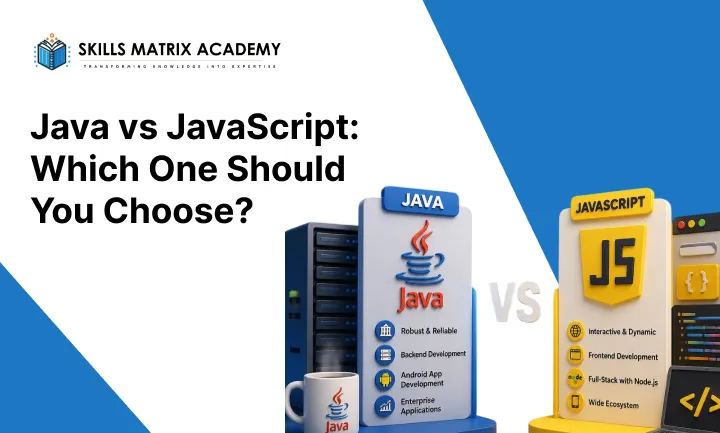
Here’s the truth: Neither language is universally better. They solve different problems.
Choose Java if you want:
- Enterprise development
- Android app creation
- Backend systems
- Strong security
- Scalability
Choose JavaScript if you want:
- Interactive websites
- Frontend development
- Fast web applications
- Full-stack flexibility
The best choice depends on your goals.
Final Thoughts on Java vs JavaScript
Understanding the difference between Java and JavaScript is important for every beginner developer. Even though the names sound similar, these technologies serve completely different purposes.
Java focuses on backend systems, Android apps, enterprise applications, and scalable software.
JavaScript powers interactive websites, frontend interfaces, and modern web applications.
Both languages are valuable. Both offer excellent career opportunities. And both continue evolving with modern technology.
If you are still deciding between Java vs JavaScript, focus on the type of projects you enjoy building most. That decision will help you choose the right learning path faster.
The good news is simple:
Learning either language can open doors to strong career opportunities in tech. Start with one language. Practice consistently. Build projects regularly. That is how real programming skills grow.
FAQs
01. What is the main difference between Java and JavaScript?
Java is a compiled programming language mainly used for backend systems and Android development. JavaScript is a scripting language mainly used for interactive websites and web applications.
02. Is JavaScript related to Java?
No. Despite similar names, Java and JavaScript are completely different programming languages.
03. Which is easier to learn: Java or JavaScript?
JavaScript is often easier for beginners because it has simpler syntax and runs directly in browsers.
04. Can JavaScript replace Java?
Not completely. JavaScript is excellent for web development, but Java remains stronger for enterprise applications and Android development.
05. Should I learn Java or JavaScript first?
Choose JavaScript if you want to become a web developer. Choose Java if you want to work on enterprise software or Android applications.

Bharat Arora
12+ years as a web developer, Bharat has worked in the biggest IT companies in the world. He loves to share his experience in web development.


Bharat Arora
12+ years as a web developer, Bharat has worked in the biggest IT companies in the world. He loves to share his experience in web development.