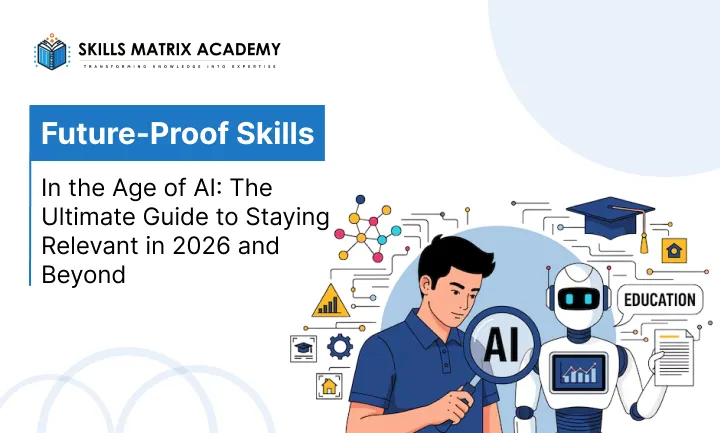
Introduction: The Reality of the AI Revolution
Let’s be honest for a second. The world is changing faster than most of us expected. Just a few years ago, AI felt like something out of a sci-fi movie. Today, it’s writing emails, generating images, coding software, and even having conversations that feel surprisingly human.
We are living through one of the biggest technological shifts in history and it’s happening right now, not decades from now.
But here’s what nobody tells you clearly enough: AI is not coming for humans. It’s coming for human habits that stopped evolving. The professionals who will do well in this new world are not necessarily the smartest or the most experienced. They’re the ones who stayed curious, kept learning, and figured out how to use AI as a tool rather than seeing it as a threat.
This guide is for people who want to be on the right side of that change.
Understanding Future-Proof Skills
Before we dive into the list, it’s worth understanding what makes a skill actually future-proof because not every trending skill deserves your time and energy.
Future-proof skills are the abilities that hold their value even as technology keeps evolving. They are either too human to automate, too creative to replicate, or too strategic to replace with a machine. They grow more valuable over time, not less. And most importantly, they work across industries so even if one sector changes, your skills travel with you.
Think of it this way. A skill that complements AI will always be more valuable than a skill that competes with it. The people who understand this early are the ones who end up ahead.
There’s also a mindset shift worth making here. Earlier generations chased job security a stable position at a good company. That idea is fading fast. What matters now is skill security. Because jobs come and go, but a genuinely skilled person always finds a way forward. Companies don’t pay for your degree anymore. They pay for your ability to walk in and solve a real problem on day one.
Top Future-Proof Skills You Must Learn
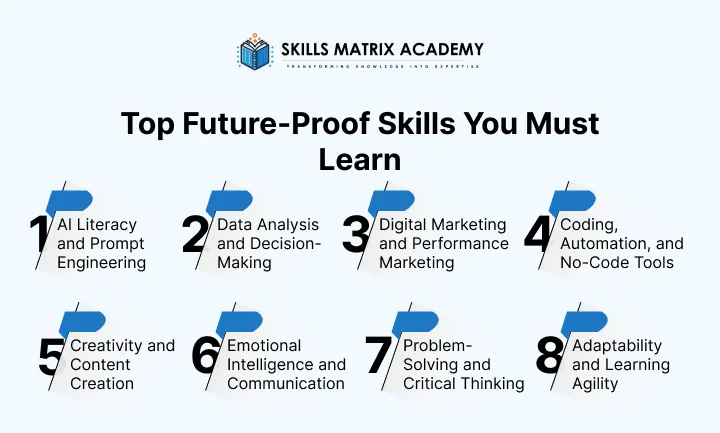
1. AI Literacy and Prompt Engineering
Here’s a simple truth: people who know how to use AI well will have a massive advantage over people who don’t. This isn’t about becoming a tech expert. It’s about being comfortable with tools like ChatGPT, Claude, Gemini, and Midjourney knowing what they can do, what they can’t, and how to get the best results out of them.
Prompt engineering sounds fancy, but it’s really just the art of knowing how to talk to AI so it gives you useful output. This is one of the most practical AI skills to learn right now, and it costs nothing to start. If you can use AI to save two hours a day on repetitive tasks, you’ve already made yourself more productive than most people in your field.
2. Data Analysis and Decision-Making
We keep hearing that data is the new oil. That’s true but only if someone actually knows how to refine it. Raw data sitting in a spreadsheet means nothing. What matters is the ability to look at that data, understand what it’s telling you, and make a smart decision based on it.
AI can generate reports and surface patterns faster than any human. But the judgment call the “what do we do with this?” question still needs a human brain. That’s where data analysis becomes one of the strongest in-demand skills for the future. If you can read a dashboard, identify what matters, and guide a team based on what you find, you’ll always have a seat at the table.
3. Digital Marketing and Performance Marketing
No matter how advanced technology gets, businesses will always need customers. That’s a fundamental truth that doesn’t change. And that’s exactly why digital marketing remains one of the most reliable future-proof skills you can build.
The highest-value areas right now are SEO including AI SEO, which is evolving fast paid advertising on platforms like Meta and Google, email marketing, and funnel building. What makes marketing so powerful as a career skill is that the results are measurable. You can directly show how your work brought in revenue. That kind of accountability makes you extremely hard to let go of and very easy to hire.
4. Coding, Automation, and No-Code Tools
You don’t need to become a software engineer to benefit from technical knowledge. But understanding how technology works even at a basic level gives you a kind of leverage that’s hard to explain until you experience it yourself.
Learning the basics of Python, understanding how APIs work, or building simple automations using tools like Zapier can transform how much you get done in a day. No-code platforms like Webflow and Notion have made it possible for non-developers to build things that would have required a full team just five years ago. The shift here is meaningful: instead of doing work, you start building systems that do the work for you. That’s a completely different level of productivity.
5. Creativity and Content Creation
This is the skill that a lot of people underestimate especially when they assume AI will just take over creative work. Yes, AI can write a blog post. It can generate an image or draft a social media caption. But it cannot replace the human who has a genuine point of view, a personal story, and the ability to connect emotionally with an audience.
Content creators who learn to use AI as a creative assistant rather than a replacement can produce more, faster, without losing what makes their voice unique. Writing, video creation, storytelling, and personal branding are all skills that AI cannot replace at the deepest level. And as the internet gets flooded with AI-generated content, genuine human creativity is only going to become more valuable.
6. Emotional Intelligence and Communication
Here’s something no algorithm can do: make someone feel truly heard. Emotional intelligence the ability to understand your own emotions and navigate the emotions of others is one of the most powerful future-proof skills that exists, and most people don’t think of it as a skill at all.
Communication, negotiation, leadership, and empathy are what hold teams together, win clients, and build companies. These are human strengths that machines cannot replicate because they require real lived experience and genuine connection. As AI handles more of the technical work, the professionals who can lead people, manage relationships, and inspire trust will only grow more valuable.
7. Problem-Solving and Critical Thinking
AI is genuinely good at answering questions. But figuring out which questions to ask in the first place? That’s still a human job. Critical thinking the ability to break down a complex situation, challenge your own assumptions, and find solutions that aren’t obvious is one of the best skills to learn in 2026 and every year after.
Companies at every level are looking for people who can think, not just people who can execute. If you bring strategic thinking and genuine problem-solving ability to a team, you become the kind of person that leadership turns to when things get complicated. That’s a position worth being in.
8. Adaptability and Learning Agility
Of all the future-proof skills on this list, this one might be the hardest to teach but also the most important to develop. The ability to learn quickly, adjust without panic, and stay open to changing direction is what separates professionals who thrive through disruption from those who get left behind by it.
The AI and job market trends are shifting every few months now. New tools appear, old ones become obsolete, and entire job categories are being reimagined. The people who can keep up not because they’re naturally smarter, but because they’ve built the habit of continuous learning will always find opportunities even when things change around them.
High-Income Skill Combinations That Change Everything
Learning one skill is good. Combining two or three complementary skills is where things get genuinely exciting. This concept sometimes called skill stacking is one of the most underused strategies for building a high-income career in the AI era.
When you pair AI literacy with marketing, you become someone who can run smarter campaigns faster than traditional marketers. When you combine content creation with SEO knowledge, you become a one-person organic growth engine. When you bring data skills into a business strategy role, you’re not just analyzing numbers you’re helping shape direction. And when you pair coding knowledge with AI tools, you become an automation builder who can do the work of an entire small team.
Each of these combinations creates a profile that’s genuinely difficult to replace. And the more uniquely you combine your skills, the less competition you’ll face because nobody else will have exactly your mix of abilities and experience.
How to Start Building Future-Proof Skills Right Now
The honest truth is that the roadmap isn’t complicated. Most people don’t struggle with knowing what to do. They struggle with actually starting and then staying consistent long enough to see results.
Start by picking one core skill that genuinely interests you. Not the one that sounds most impressive, and not the one your friend is learning. The one that actually keeps your attention when you study it at 10 PM after a long day. That interest is what will carry you through the hard parts.
Once you’ve chosen your focus, use a combination of free and paid resources to build real knowledge not just surface-level familiarity. YouTube is great for foundations. Structured courses add the kind of depth that turns knowledge into capability. Real case studies show you how things work when actual money and real clients are involved.
Then build something. Run a social media page, launch a small ad campaign, create a website, write a newsletter. Learning without doing is just expensive procrastination. The projects you build even imperfect, early ones become the portfolio that proves your skills to every future employer or client.
From there, start looking for ways to earn from what you’re building. Freelancing and internships give you real-world pressure that accelerates learning faster than any course. A personal brand built in public compounds over time. Digital products let you earn while you sleep. None of these require you to be perfect they just require you to start.
Common Mistakes That Will Keep You Stuck
The biggest reason people fall behind in the AI era isn’t a lack of talent or opportunity. It’s a set of avoidable habits that quietly slow everything down.
Consuming endless content without ever applying it is probably the most common trap. Watching tutorials, reading articles, taking courses none of it matters if it never translates into something real. Chasing too many future-proof skills at once is another version of the same problem. You end up knowing a little about a lot and not enough about anything to actually get hired or paid.
Avoiding new technology out of discomfort or unfamiliarity is a choice that compounds negatively over time. So is waiting for the perfect moment to start because that moment genuinely never arrives. And relying only on theory while skipping practical experience leaves you with knowledge that sounds impressive but doesn’t actually hold up when real problems show up.
The Role of AI: Threat or Opportunity?
This question comes up constantly, and the honest answer is that it depends entirely on what you do with the information.
AI is not your competition. It is the biggest productivity tool most people have ever had access to and most people are barely using it. The professionals who win in this era will be the ones who use AI to save time, scale their output, and focus their human energy on the things that actually require human judgment. The ones who lose will be those who spend the next few years resisting something that’s already here to stay.
Building skills for the age of AI doesn’t mean becoming a robot or learning to code from scratch. It means being the kind of professional who understands how AI fits into their work, uses it strategically, and still brings the human depth that no machine can replicate.
Future Trends Worth Watching
The rise of AI-powered businesses is creating entirely new categories of work that simply didn’t exist a few years ago. The creator economy continues to reward people who build genuine skills and authentic audiences. Automation is replacing routine jobs faster than most industries expected which makes now the most urgent possible time to invest in future-proof skills that sit above that automation threshold.
Perhaps most importantly, demand for hybrid professionals people who can operate at the intersection of technical knowledge and human skill is growing faster than the talent pool can keep up. That gap is where the best opportunities are hiding right now.
Conclusion: Your Future Depends on Your Skills
The world is not going to slow down and wait. But that’s actually good news because it means the gap between people who act now and people who wait is going to keep growing, and you get to choose which side of that gap you’re on.
Start building future-proof skills today even imperfectly, even slowly and you set yourself up for a career that can survive disruption, adapt to change, and create real value in the AI-driven world that’s already forming around us. These aren’t just best skills to learn in 2026. They’re the foundation of a professional life that stays relevant for decades.
The goal was never just to adapt to the future. The goal is to be one of the people who builds it.

Bharat Arora
12+ years as a web developer, Bharat has worked in the biggest IT companies in the world. He loves to share his experience in web development.

Bharat Arora
12+ years as a web developer, Bharat has worked in the biggest IT companies in the world. He loves to share his experience in web development.