Introduction
Technology is changing at full speed.
New tools launch every month.
Companies now use automation, cloud systems, and smart algorithms daily.
That’s why many students feel stuck.
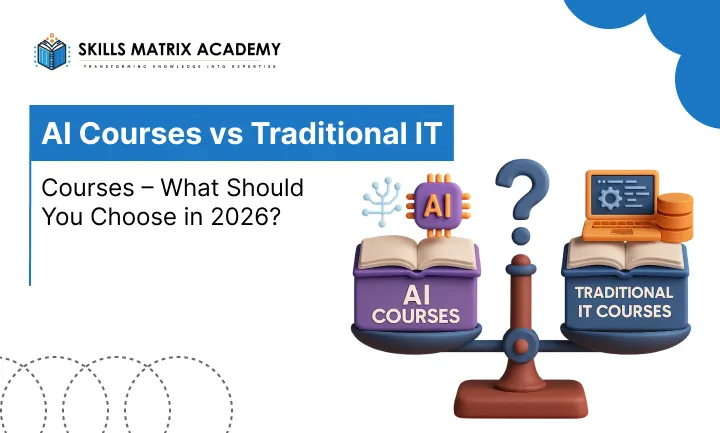
Should you choose AI Courses vs Traditional IT Courses?
Both look powerful.
Both promise strong careers.
But both are very different.
In this detailed AI Courses vs Traditional IT Courses guide, you’ll learn about skills, salary, growth, and long-term demand. By the end, you’ll clearly understand which path fits you best in 2026.
Let’s break it down step by step.
What Are AI Courses?
AI courses focus on building smart systems. These systems analyze data and gradually improve their performance over time. Instead of writing fixed rules, you train machines to find patterns.
This is why many people compare AI course vs IT course when looking for the best tech course in 2026.
AI programs usually cover:
- Machine Learning
- Deep Learning
- Data Science
- Natural Language Processing
- Computer Vision
- Python programming
These subjects build the foundation of the Machine Learning career path.
Many students choose AI because of the strong Artificial Intelligence course benefits. These include higher salary potential, cutting-edge projects, and strong global demand.
But AI is not easy.
Skills Required for AI Jobs
To succeed in AI, you need:
- Strong math skills (statistics and linear algebra)
- Solid coding knowledge in Python
- Deep logical thinking
- Data analysis skills
These are core skills required for AI jobs. Without them, AI becomes difficult.
The Future of Artificial Intelligence careers looks strong. Companies now use AI in finance, healthcare, e-commerce, and cybersecurity. AI job opportunities 2026 are expected to grow faster than many other tech roles.
Still, remember one thing.
AI is specialized. It requires focus, discipline, and constant learning.
What Are Traditional IT Courses?
Traditional IT courses focus on building and managing systems. Instead of training models, you build software, websites, networks, and databases.
This is why the debate of AI Courses vs Traditional IT Courses is important.
Traditional IT includes:
- Web development
- Software engineering
- Networking
- Cybersecurity
- Database management
- Cloud computing
When students compare Machine Learning course vs Software Development, they often forget that software development forms the backbone of tech systems.
IT courses are broader. They are beginner-friendly. They help you build strong programming skills for beginners before moving into advanced fields.
Skills Required for IT Jobs
To grow in IT, you need:
- Basic to moderate coding skills
- Logical thinking
- Understanding of operating systems
- Practical project-building experience
These are key skills required for IT jobs.
The IT industry job demand remains stable. Every company needs developers, system engineers, and security experts. IT career scope 2026 remains strong because businesses depend on digital infrastructure.
Unlike AI, IT focuses more on execution than experimentation.
AI vs IT Career Comparison
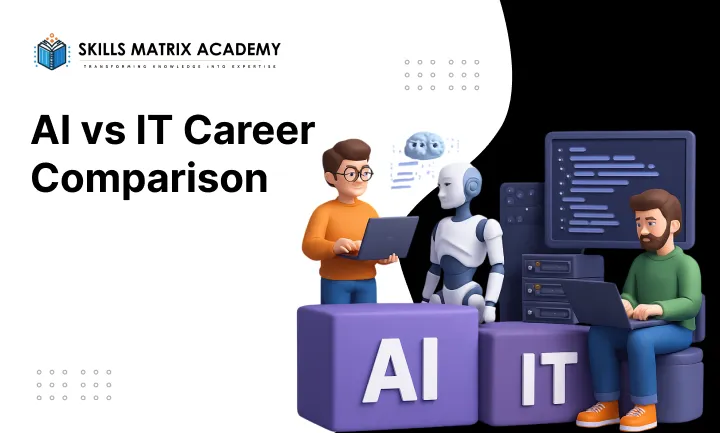
Let’s simplify the AI vs IT career comparison.
AI has a steeper learning curve. IT offers easier entry.
AI requires strong math. IT requires structured coding knowledge.
AI often offers higher starting packages. IT provides better IT job stability.
Here’s the clear difference:
- AI = High risk, high reward
- IT = Stable, consistent growth
When students ask, Which course is better AI or IT, the answer depends on personal strengths.
If you enjoy data, patterns, and research, AI suits you.
If you enjoy building apps, websites, or managing systems, IT fits better.
This makes AI Courses vs Traditional IT Courses a personal decision, not a trend-based one.
AI Salary vs IT Salary in India (2026)
Salary matters. Let’s talk numbers.
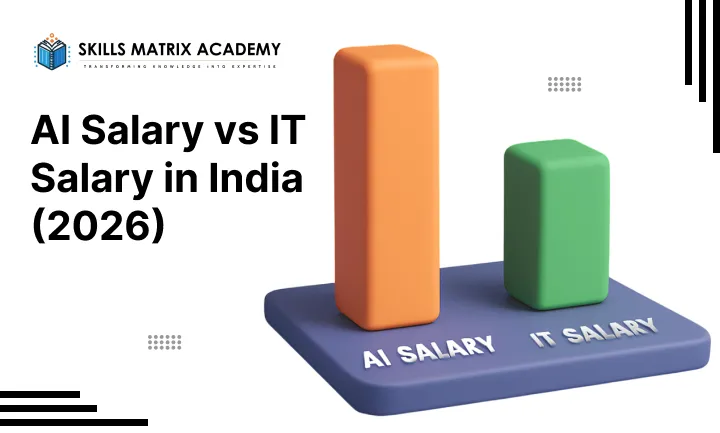
In India, AI roles usually offer:
- Freshers: ₹6–12 LPA
- 3–5 years experience: ₹15–25 LPA
This reflects the rising AI engineer salary in India.
Traditional IT roles offer:
- Freshers: ₹3–7 LPA
- 3–5 years experience: ₹8–18 LPA
When we look at software developer salary comparison, IT may start lower but grows steadily.
This is why AI salary vs IT salary becomes a major deciding factor.
AI may pay more initially. But it demands stronger skills.
IT pays moderately. But it provides stability and consistent opportunities.
Future Scope 2026–2030
Professionals with hybrid skills will shape the next era of technology.
AI will continue expanding in:
- Healthcare diagnostics
- Financial fraud detection
- Automation systems
- Smart retail solutions
- Cybersecurity analytics
These trends strengthen the Future of Artificial Intelligence careers.
However, AI cannot run without IT.
Developers build the applications.
Cloud engineers manage servers.
Database experts handle data storage.
That’s why IT career scope 2026 remains strong.
Many experts now recommend combining both paths. Start with IT fundamentals. Then move into AI certification courses or data science specialization.
This reduces risk and increases growth.
Who Should Choose AI?
Choose AI if:
- You love math and statistics
- You enjoy solving complex data problems
- You want high paying tech courses
- You can handle continuous learning
AI works well for students from B.Tech AI vs B.Tech IT backgrounds who enjoy advanced technical subjects.
AI career in India is growing fast. But competition is intense.
If you want specialization and high salary potential, AI is powerful.
Who Should Choose Traditional IT?
Choose IT if:
- You want quicker job entry
- You prefer practical coding
- You want structured growth
- You are starting after 12th and need strong basics
For many students, IT is the best course after 12th for tech because it builds foundation skills first.
Traditional IT course career options remain diverse. You can move into development, cloud, cybersecurity, or even management roles later.
IT offers flexibility.
Smart Career Strategy
Instead of choosing one extreme, take a smarter path.
Start with:
- Core programming skills
- Databases and system design
- Real-world projects
Then move into:
- Data Science vs Software Engineering specialization
- AI certification courses
- Machine Learning career path
This way, you gain both stability and high-growth opportunities.
This balanced method wins in the long term.
Final Verdict
There is no single winner in AI Courses vs Traditional IT Courses.
Both are powerful.
If you want advanced specialization and strong salary potential, AI is excellent.
If you want steady growth and job stability, IT is reliable.
The smartest professionals combine both.
Remember this: companies hire skilled problem solvers. They don’t just hire degrees.
So instead of worrying about AI course vs IT course, focus on building real projects, real experience, and real skills.
In 2026 and beyond, the best tech course in 2026 will always be the one that matches your strengths and long-term goals.
Choose smart.
Build skills daily.
Stay updated.
FAQ’s
What are hybrid professionals in the tech industry?
Hybrid professionals are individuals who combine skills from multiple fields, such as technology, business, marketing, or design.
Why are hybrid skills important in the tech industry?
Hybrid skills help professionals solve complex problems, collaborate across teams, and adapt to changing technologies.
Which skills make someone a hybrid tech professional?
Skills like programming, data analysis, digital marketing, project management, and communication can help create a hybrid skill set.
How can beginners develop hybrid tech skills?
Beginners can start by learning a core tech skill and then add complementary skills like analytics, UX design, or marketing.
Are hybrid professionals in high demand?
Yes, many companies prefer hybrid professionals because they can handle multiple responsibilities and bring diverse perspectives to projects.

Bharat Arora
12+ years as a web developer, Bharat has worked in the biggest IT companies in the world. He loves to share his experience in web development.

Bharat Arora
12+ years as a web developer, Bharat has worked in the biggest IT companies in the world. He loves to share his experience in web development.