Introduction: Why Everyone’s Talking About Prompt Engineering
AI tools are no longer optional. They are everywhere. People now use them to write content, generate code, design images, plan marketing campaigns, and automate daily work. Tools like ChatGPT, Claude, and Gemini are already part of normal workflows. Because of this shift, prompt engineering courses are getting massive attention.
Prompt engineering sounds technical, but the idea is simple. It is about knowing how to ask AI the right way. The better your instructions, the better the results you get. That is why many people now believe prompt engineering skills are just as important as core job skills.
As demand grows, prompt engineering online courses and certifications are launching fast. Some promise career growth. Others promise instant mastery. This makes many learners pause and think. Are prompt engineering courses worth it, or is this another short-term trend? To answer that, we need to understand the skill properly.
What Is Prompt Engineering?
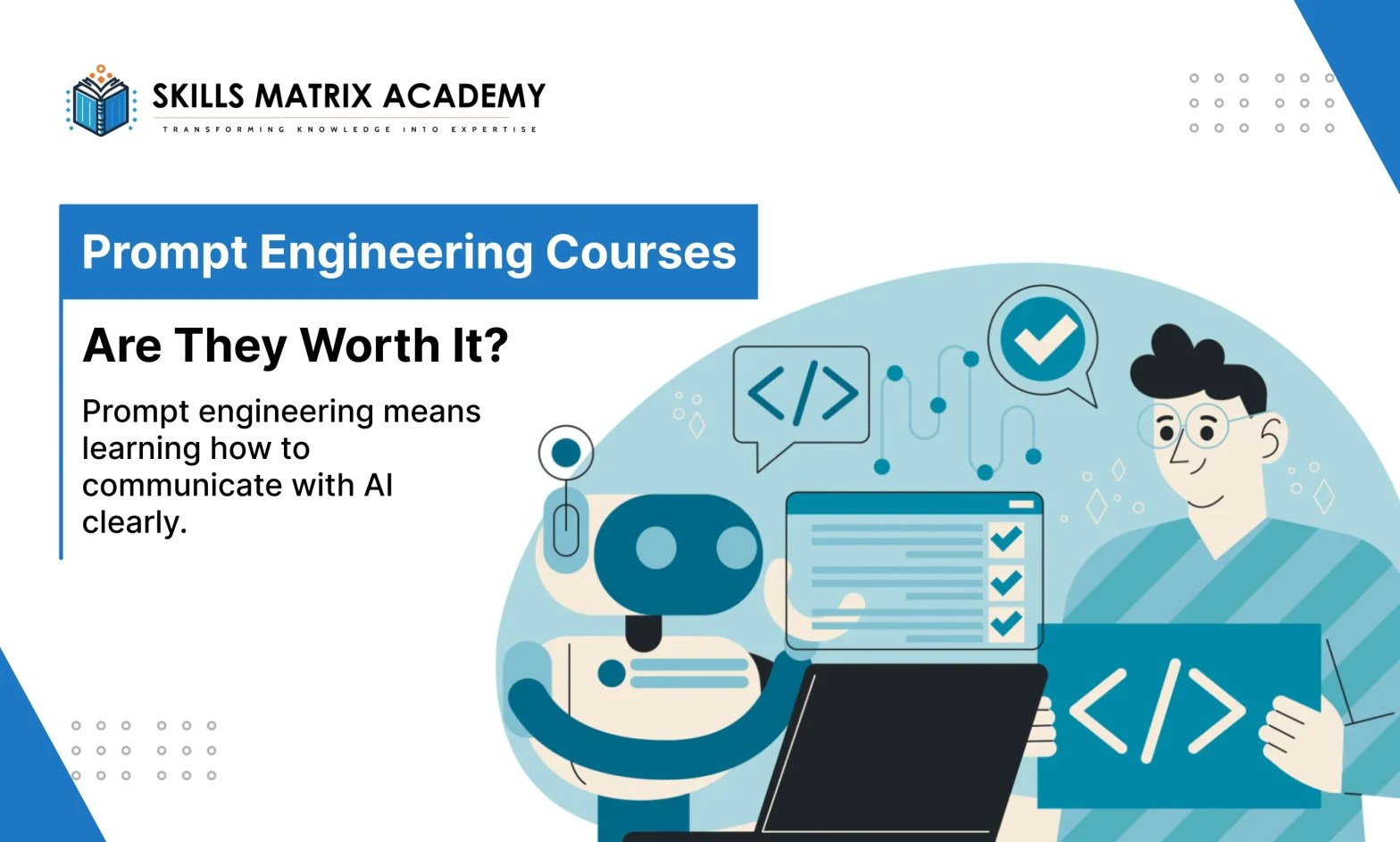
Prompt engineering means learning how to communicate with AI clearly. Nothing more. Nothing less. A prompt is the instruction you give to an AI tool. It tells the AI what you want, how you want it, and why you want it.
Small changes in wording can completely change the output. That is how prompt engineering works. A vague instruction gives a weak response. A clear instruction gives a strong, usable result.
Prompt engineering examples are everywhere. Content creators use it to write blogs and ads. Developers use it to debug code. Marketers use it to plan SEO strategies. Designers use it for image prompts. Teams use it for automation, SOPs, and emails. This is why AI prompt engineering is becoming a core digital skill.
Prompt engineering is not about complex formulas. It is about clear thinking, structured instructions, and understanding context.
Why Prompt Engineering Became a Course-Worthy Skill
Prompt engineering did not become popular by accident. Several changes pushed it forward at the same time.
AI tools are launching faster than ever. Every tool depends on prompts. Businesses want results, not experiments. They expect teams to use AI efficiently. This demand created space for prompt engineering training.
Another big reason is accessibility. Non-technical professionals now use AI daily. Writers, marketers, founders, and analysts rely on it. They want faster and more accurate outputs without learning to code. Prompt engineering for beginners helps fill that gap.
Social media also played a role. Creators turned prompt tips into paid products. Over time, prompt engineering shifted from casual tips to a structured learning path. This made prompt engineering courses feel legitimate and useful.
What Do Prompt Engineering Courses Usually Teach?
Most prompt engineering courses follow a similar structure. They focus on how AI models respond to instructions and context. Learners study AI prompt frameworks like zero-shot prompting, few-shot prompting, and chain-of-thought prompting.
Courses also teach role-based and goal-based prompting. This helps users guide AI with clear intent. Many programs include prompt engineering use cases for marketing, coding, data analysis, image generation, and automation.
Another key area is mistakes. Courses explain why vague prompts fail and how missing context reduces output quality. Some also cover ChatGPT prompt engineering, Claude prompt techniques, and Gemini AI prompting.
Course quality varies. Some go deep and practical. Others stay shallow. This difference matters when deciding if a prompt engineering course is worth it.
The Big Question: Are Prompt Engineering Courses Worth It?
The honest answer is simple. Prompt engineering courses are worth it for the right person.
They work well for beginners with no AI background. They help people who want structure instead of guessing. They are useful for professionals who rely on AI for work. For them, saving time matters more than saving money.
However, prompt engineering courses may not help everyone. If you already experiment daily, free resources may be enough. If you learn best by practice and documentation, paid courses may feel repetitive. Some courses only teach generic prompts. Those are rarely worth the price.
There is no hype here. Just alignment. The value depends on your learning style and goals.
Free Learning vs Paid Courses: What’s the Real Difference?

Free resources are everywhere. Blogs, videos, and guides explain what is prompt engineering and how it works. But the information is scattered. Learning takes time and patience.
Paid prompt engineering online courses offer structure. They provide a clear learning path, examples, and sometimes feedback. Many also include communities and assignments.
The main difference is speed. You are not paying for secrets. You are paying for clarity, curation, and direction.
How to Judge If a Prompt Engineering Course Is Actually Good
Before buying any prompt engineering certification, check a few things. A good course shows real-world use cases. It stays updated with current AI models. It explains why prompts work, not just what to type.
Strong courses teach thinking. Weak ones teach copy-paste templates. Instructor credibility matters too. The best teachers actively use AI in real work. This is critical for building real prompt engineering skills.
Career Impact: Will This Skill Really Help You Earn More?

Prompt engineering alone will not guarantee a high salary. That is the truth. But prompt engineering + another skill can change career outcomes.
This combination works especially well in marketing, development, product management, data analysis, and automation. Prompt engineering for marketing improves campaign speed. Prompt engineering for developers speeds up debugging. Prompt engineering for automation reduces manual work.
Think of prompt engineering as a skill multiplier. It enhances what you already know. It is not a shortcut, but it is powerful.
So… Should You Take a Prompt Engineering Course?
If you want faster results, structured learning helps. If you aim to grow in AI-driven roles, a course can support your prompt engineering career. If you expect overnight success, you will be disappointed. If you dislike structured learning, free practice may suit you better.
There is no wrong choice. Only the right fit.
Final Verdict: Hype or Helpful?

Prompt engineering courses are not scams. But they are not golden tickets either. The real value comes from daily practice, experimentation, and solving real problems with AI.
Learn the basics. Apply them often. Use free resources first if needed. Pay for structure only when it helps you move faster. That is the smartest prompt engineering learning path going forward.
FAQs
- Can I learn prompt engineering for free?
Yes. Many free prompt engineering resources exist. Paid courses mainly save time. - Do companies really hire prompt engineers?
Rarely as a standalone role. More often as part of another job. - How long does it take to learn prompt engineering?
Basics take days. Mastery comes with regular use. - Are prompt engineering certificates valuable?
They support learning but do not guarantee jobs. - Is prompt engineering future-proof?
Tools may change, but clear instruction skills remain valuable.

Bharat Arora
12+ years as a web developer, Bharat has worked in the biggest IT companies in the world. He loves to share his experience in web development.


Bharat Arora
12+ years as a web developer, Bharat has worked in the biggest IT companies in the world. He loves to share his experience in web development.