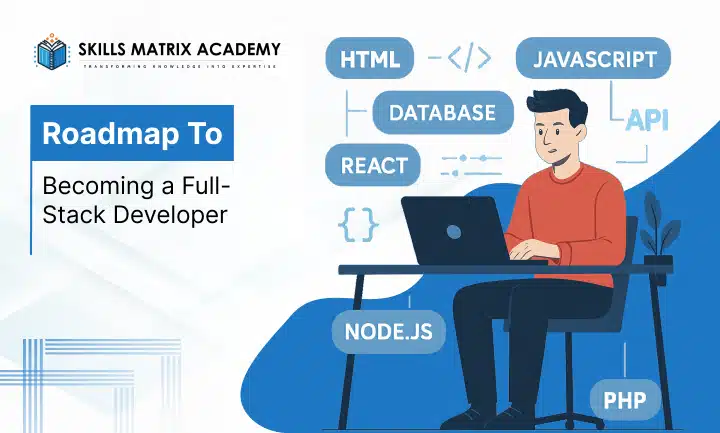
Full-stack development is no longer just a trend. It has become a core skill set that modern tech companies actively look for. Today’s businesses want developers who understand the whole picture — from how users interact with an interface to how data flows through servers and databases.
A full stack developer has the skills to build an entire web application, covering everything from the user interface to the backend systems.This includes designing the user interface, writing server-side logic, managing databases, deploying applications, and maintaining them in production. Because of this broad skill set, full-stack developers are among the most versatile and future-ready professionals in the tech industry.
If you are searching for a clear, practical, and future-ready Full Stack Developer Roadmap, this guide is designed for you. It combines industry-proven learning paths with real-world expectations, making it suitable for beginners and professionals planning to upskill in 2026 and beyond.
What Is Full Stack Development?
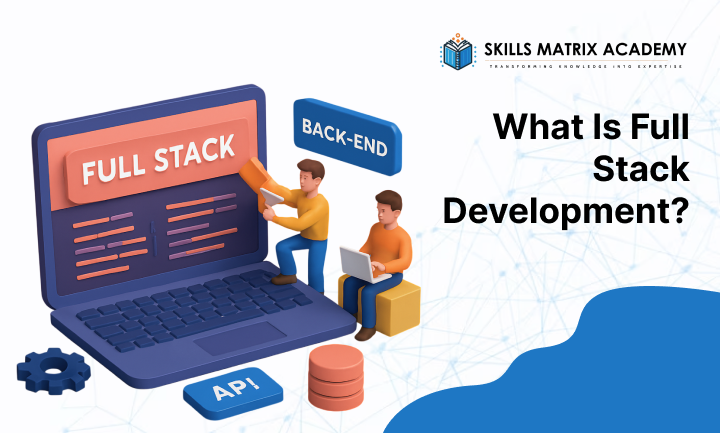
Full-stack development means handling both the user-facing interface and the server-side logic of a web application. Instead of focusing on a single layer, a full-stack developer understands how every part of the system works together.
In simple terms, a full-stack developer understands:
- How users interact with a website (UI and UX)
- How servers handle requests and business logic
- How databases store, organise, and retrieve data
- How do APIs allow different parts of an application to communicate
- How applications are deployed, monitored, and scaled
Because of this end-to-end understanding, full-stack developers are often trusted with larger responsibilities and faster decision-making.
Why Choose Full Stack Development as a Career?

Full-stack development offers a potent combination of job security, flexibility, and long-term growth. As companies move faster and teams become leaner, developers who can handle multiple responsibilities are in high demand.
Some of the key advantages of choosing full-stack development include:
- High demand across industries such as startups, SaaS, fintech, healthcare, and e-commerce
- Broader career opportunities, including frontend, backend, DevOps, and technical lead roles
- Better salary potential due to multi-skill expertise
- Strong freelancing and remote work opportunities
- Faster career growth because you understand the complete system
Companies value developers who can independently build, debug, deploy, and scale applications. That is why full-stack development remains a stable and rewarding career choice.
Complete Stack Developer Roadmap (Step by Step)
This roadmap follows a logical and beginner-friendly learning order. You start with the fundamentals, then gradually move toward advanced, production-level skills. Each stage builds on the previous one, making learning smoother and more effective.
1. Web Fundamentals (Your Foundation)
Every successful full-stack developer starts with strong web fundamentals. These basics help you understand how the web actually works.
You should focus on:
- HTML for structure, including semantic elements, forms, and accessibility basics
- CSS for layout and design, covering Flexbox, Grid, responsive design, media queries, and simple animations
- JavaScript for core logic such as variables, functions, loops, DOM manipulation, events, and the Fetch API
At this stage, your goal is to build simple, responsive, and interactive websites confidently.
2. Modern JavaScript and Frontend Tools
Once the basics are straightforward, it’s time to move toward modern JavaScript and professional tooling. This stage helps you write cleaner, more efficient, and scalable code.
Key areas to learn include ES6+ features, promises, async/await, modules, and proper error handling. Alongside JavaScript, you should also understand how package managers and build tools work.
Commonly used tools include:
- npm or yarn
- Webpack
- Vite
- Parcel
These tools are essential for managing dependencies and optimising performance in real-world applications.
3. Frontend Frameworks and UI Development
Frontend frameworks enable you to build large, maintainable applications efficiently. Instead of writing everything from scratch, you work with reusable components.
Popular framework choices include React.js, Angular, Vue.js, and Next.js. While each has its own strengths, React remains the most in-demand in the job market.
For styling, developers commonly use:
- Tailwind CSS
- Bootstrap
- Material UI
Your goal here is to build dynamic, component-based user interfaces with clean design and good performance.
4. Version Control and Collaboration
Version control is a must-have skill for professional developers. It allows teams to collaborate, track changes, and manage code safely.
You should be comfortable with:
- Git fundamentals such as commit, branch, and merge
- Platforms like GitHub, GitLab, or Bitbucket
Strong Git skills make teamwork smoother and reduce the risk of errors in production.
5. Backend Development (Server-Side Skills)
Backend development handles the logic behind the scenes. It processes user requests, manages authentication, and communicates with databases.
Popular backend technologies include Node.js with Express, Python frameworks such as Django and Flask, Java with Spring Boot, PHP with Laravel, and C# with .NET Core.
Essential concepts you must understand:
- RESTful APIs
- Authentication and authorisation
- Middleware
- Error handling
- Server-side validation
At this stage, your focus should be on building secure and scalable APIs.
6. Database Management (Data Layer)
Databases store the most valuable part of any application — data. Understanding how data is structured and accessed is critical.
You should learn both SQL and NoSQL databases.
SQL options include MySQL and PostgreSQL, while NoSQL options include MongoDB and Firebase.
Key database skills include schema design, relationships, CRUD operations, indexing, and basic performance optimisation.
7. API Design and Integration
APIs act as a bridge, connecting the front end and back end of an application. Well-designed APIs make applications easier to scale and maintain.
You should understand REST principles, JSON handling, JWT authentication, API versioning, and basic GraphQL concepts.
Good API design improves both developer experience and application performance.
8. DevOps, Deployment, and Cloud Basics
Writing code is only part of the job. You must also know how to deploy and manage applications in production.
Essential skills include Linux basics, cloud platforms such as AWS, GCP, or Azure, Docker and containers, CI/CD pipelines, and environment variables.
These skills help you confidently move applications from development to production.
9. Testing and Performance Optimisation
Professional applications require testing and optimisation. Testing ensures reliability, while optimisation improves speed and user experience.
You should understand unit testing, integration testing, and end-to-end testing. Performance topics include code splitting, caching, lazy loading, and database query optimisation.
10. Security Best Practices
Security is non-negotiable in modern web development. Even small mistakes can lead to serious vulnerabilities.
You should learn about HTTPS and SSL, SQL injection prevention, XSS and CSRF protection, secure authentication, and data encryption.
Secure applications build trust with users and clients.
11. Soft Skills and Professional Practices
Technical skills alone are not enough. Strong soft skills help you grow into senior and leadership roles.
These include problem-solving ability, clear communication, proper documentation, time management, and team collaboration.
Popular Full Stack Technology Stacks
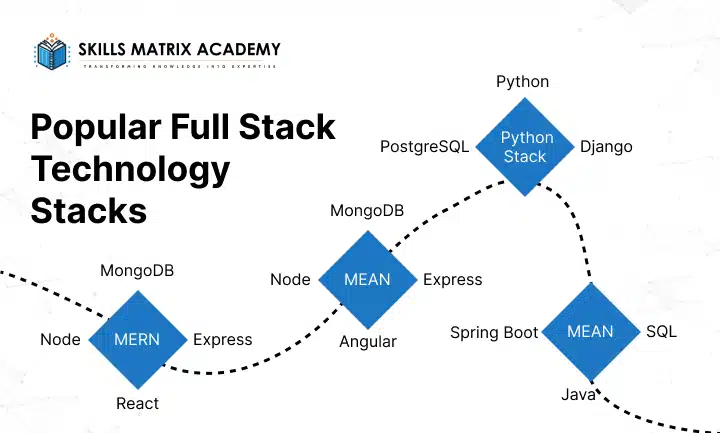
Some commonly used full-stack technology combinations include:
- MERN: MongoDB, Express, React, Node
- MEAN: MongoDB, Express, Angular, Node
- Python Stack: Python, Django, PostgreSQL
- Java Stack: Java, Spring Boot, SQL
It is better to master one stack deeply than to learn many stacks superficially.
Real-World Project Ideas
Projects turn theoretical knowledge into fundamental skills. They also play a significant role during interviews.
Good project ideas include a portfolio website, blog platform, e-commerce application, admin dashboard, chat application, REST API service, and a cloud-deployed full-stack app.
How Long Does It Take to Become a Full Stack Developer?
The learning timeline depends on consistency and practice.
- Beginner to junior level: 6–9 months
- Job-ready level: 9–12 months
- Advanced or senior level: 2+ years of experience
Consistency matters more than speed.
Career Paths After Full Stack Development

Once you gain full-stack development skills, your career options expand significantly. Because you understand both frontend and backend systems, you are not limited to a single role. You can shift your focus based on interest, company needs, or long-term goals.
Common career paths include:
- Frontend Developer – focusing on UI performance, accessibility, and user experience
- Backend Developer – specialising in APIs, databases, and system architecture
- Full-Stack Engineer – handling end-to-end product development
- DevOps Engineer – managing deployment, automation, and infrastructure
- Technical Lead or Architect – designing scalable systems and mentoring teams
- Freelancer or Consultant – working independently with global clients
Full-stack development gives you the flexibility to grow both horizontally and vertically in your career.
Learning Strategy for Faster Results
Having a roadmap is essential, but how you learn matters just as much. Many learners fail not because the roadmap is wrong, but because their learning approach is unstructured.
To get faster and better results, follow these proven strategies:
- Learn concepts first, then apply them immediately in small projects
- Focus on one technology stack at a time instead of jumping between tools
- Read official documentation regularly to build strong fundamentals
- Practice debugging daily, as it is a real-world skill
- Contribute to GitHub or open-source projects to gain exposure
- Build at least 3–5 complete, deployable projects before applying for jobs
Even 2–3 focused hours every day can lead to substantial progress if done consistently.
Common Mistakes Beginners Should Avoid
Many aspiring developers slow down their growth by making avoidable mistakes. Being aware of these early can save you months of effort.
Some common mistakes include:
- Skipping fundamentals and jumping directly to frameworks
- Watching tutorials without building projects
- Learning too many technologies without mastering any
- Ignoring Git, testing, and deployment
- Avoiding backend or databases due to fear
Steering clear of these common errors can help you learn faster and make your overall progress more efficient.
Complete Stack Developer Skills Checklist
Before calling yourself job-ready, make sure you are comfortable with the following skills:
- Building responsive and accessible frontend applications
- Creating REST APIs with authentication and validation
- Designing, querying, and optimising databases
- Using Git confidently in team workflows
- Deploying applications on cloud platforms
- Securing applications against common vulnerabilities
- Debugging and improving application performance
This checklist closely matches what hiring managers look for in real interviews.
Why Choose Skills Matrix Academy for Full Stack Developer Training?
At Skills Matrix, we believe strong careers are built on the right skills and guidance. Our training program is designed to make full-stack development simple, practical, and career-focused.
Learn With a Clear Roadmap
Our full-stack developer training follows a structured and easy-to-understand roadmap. You start from the basics and gradually move toward advanced, job-ready skills. Each module builds on the previous one, so learning feels smooth instead of overwhelming.
You learn both frontend and backend development in depth and understand how complete applications are built, deployed, and maintained in real-world scenarios.
Real Projects. Real Skills.
Practical, real-world practice is a key focus of how we teach and train learners. Throughout the course, you work on real-world projects, including e-commerce websites and SaaS applications.
This practical exposure helps you:
- Apply full-stack development concepts in real situations
- Improve problem-solving and debugging skills
- Build confidence in writing production-level code
Industry-Ready and Future-Focused
The curriculum is regularly updated with modern tools and industry trends. You gain exposure to AI integration in web development, AI-powered applications, and modern DevOps practices.
You also learn cloud deployment, Docker, Kubernetes basics, and CI/CD pipelines, which are essential for today’s production environments.
Designed for Long-Term Career Growth
This program is suitable for beginners as well as professionals looking for upskilling. With a clear roadmap, real projects, and practical training, you build skills that support long-term growth in the tech industry.
With Skills Matrix Full Stack Development course, you don’t just learn technologies. You build confidence, real-world skills, and a strong foundation for a successful programming career.
Final Conclusion
The Full Stack Developer Roadmap (2026) is your blueprint for becoming a skilled, future-ready software professional. You do not need to learn everything at once. What matters most is learning step by step and consistently applying what you know.
Focus on mastering the fundamentals. Build real projects. Understand how applications work in production. Keep improving with every project.
If you stay consistent and follow this roadmap with discipline, you can confidently build a successful, long-lasting career in full-stack development.

Bharat Arora
12+ years as a web developer, Bharat has worked in the biggest IT companies in the world. He loves to share his experience in web development.


Bharat Arora
12+ years as a web developer, Bharat has worked in the biggest IT companies in the world. He loves to share his experience in web development.